Homeowners Insurance and Major Appliances

Shield Insurance Agency Blog | Homeowners Insurance |

Is a home appliance covered by a standard homeowners insurance policy

We often overlook our home appliances until there’s an issue — the refrigerator quits, a tree crashes into our A/C unit or an oven is damaged beyond repair in a kitchen fire.

But maybe it’s time we start to take notice. After all, home appliances are some of the hardest working members of our homes, and the cost to replace a home appliance can be significant. An A/C unit, for example, can cost anywhere from $2,000 to $10,000 to replace.

Before an issue arises, take the time to speak with one of our insurance agents and find out when your home appliances are covered by the standard homeowner’s insurance policy. Prepare now so you can more quickly replace your home appliance when you need it most.

When are home appliances covered by a standard Homeowners Insurance policy?

When it applies to your Homeowners Insurance Policy.

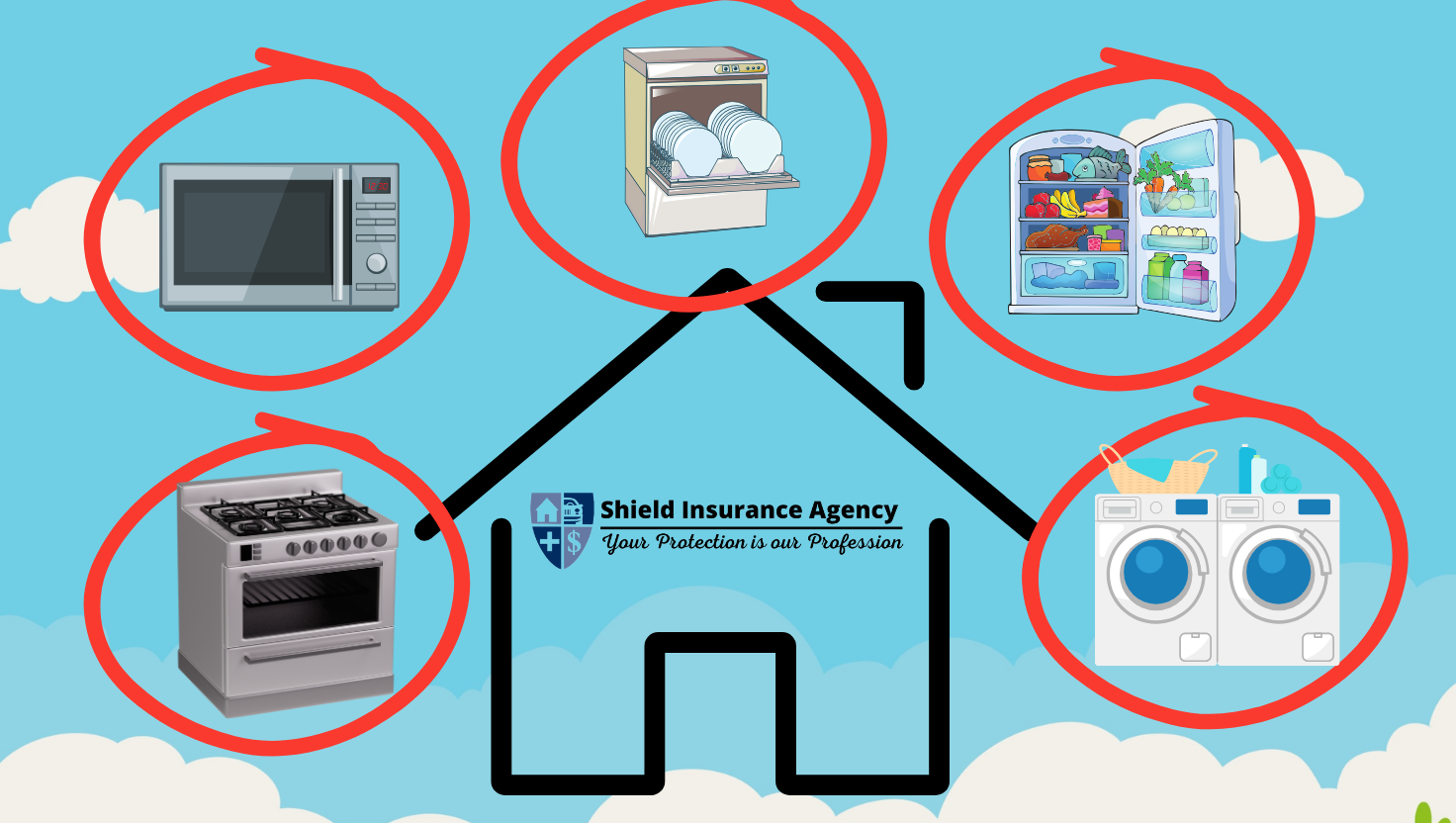
All of the home appliances that help keep your home running are typically covered by a standard homeowners’ insurance policy when a peril covered by that policy is the culprit. So, if your oven is destroyed during a kitchen fire or if someone steals your toaster oven during a burglary, those losses would be covered by home insurance.

Appliances that are installed at your home, like your HVAC system, are also typically covered by a standard homeowners’ insurance policy.

Not covered when the issue is caused by age or normal wear and tear.

Similar to other types of insurance coverage, a home appliance would not be covered by a standard homeowners insurance policy if the issue is caused by age or normal wear and tear. Also remember that if you’re renting your home, your landlord is typically responsible for maintaining or replacing any home appliances that came with the property.

If you’re unsure if your home appliance would be covered by your home insurance policy, call or text our office at 616-896-4600 and one of our agents will help you review your home insurance policy and answer any questions you have.


More blog posts by Shield Insurance

Read More

16 Car Insurance Discounts

16 car insurance discounts to ask your agent about

You don’t have to skimp on quality to get the kind of car insurance that fits your unique needs and your budget. In fact, car insurance discounts can help you get the best of both.

Shield Agency is a knowledgeable resource that can help you become aware of and take advantage of any car insurance discounts that are available to you. The next time you speak with your insurance agent, use this list to get the conversation started. Consider asking about these 16 car insurance discounts to see if you qualify.

Common car insurance discounts

These discounts are available through most car insurance companies

  1. Safe driver discount – Haven’t been at fault in an accident or received a ticket in a long time? Having a good driving record can save you money on your car insurance.
  2. Good student discount – If you have a student on your policy with no chargeable accidents, excessive speed violations or major violations, you could qualify for this discount.

  3. Multiple policy discount – When you purchase multiple policies with the same insurer (home, auto, life, etc.), you may be able to “bundle” your policies and receive this discount.
  4. Multi-vehicle discount – If you have multiple vehicles you’re adding to your auto policy, you could receive this discount.
  5. Paid in full discount – For policyholders who pay in full before their due date, you could receive this discount.
  6. Electronic payment discount – Paying your bill online or setting up automatic payments can help reduce your car insurance costs with this discount.
  7. Student away discount – You can receive this discount while your college student is away at school and not using a vehicle.
  8. Homeowner discount – Own your home, townhouse or condominium? You’ll qualify and be able to save on your auto insurance with this discount.
  9. Legacy loyalty discount – Your child will receive this discount when they move off your policy and onto their own policy with the same insurance carrier.
  10. Advance quote discount – A new customer whose auto policy starts at least one day after receiving their quote will receive a discount.

Less common car insurance discounts

Some car insurance carriers offer unique discounts to help you save on your auto insurance.

  1. Education discount – You’ll receive a discount if you or your spouse has completed post high school education. This discount is based on the highest level of education achieved.
  2. New beginning discount – This discount is available for customers who are recently divorced or separated.
  3. Full coverage discount – For those who purchase Collision Coverage on all vehicles on their policy, you can receive this discount.
  4. Occupation discount – You’ll receive a discount based on the occupation level of you or your spouse.
  5. Violation free discount – You’ll receive this discount if you’ve had no chargeable violations for three or more years.

  6. Young operator renewal – New drivers will receive a discount based on the length of the current customer’s policy with Grange.

Contact our office and let us find the best policy for your best coverage!

Read More

Ladder safety tips everyone should know

Ladder Safety

Ladder Safety. Remember in old cartoons when the main character is caught wobbling at the top of an extension ladder? A funny skit ensues as the ladder inevitably begins to fall and a friend scurries around under an expanding shadow trying to catch them.


Scaling a ladder in real life, we know, is a lot more serious. According to OSHA, portable ladders (step, straight, combination, and extension ladders) are one of the leading causes of falls and injuries to workers on the job. Knowing how to use a ladder properly at home or at work decreases your chances of risk and injury.

From cleaning your gutters to fixing a roof, you’ll most likely need a ladder to get the job done. Keep these ladder safety tips in mind the next time you climb to ensure the job is completed in a safe and timely manner.

Before use

Preparation is key to ladder safety. Keep these tips in mind before you climb:

  • Inspect the ladder for cracked or broken parts such as rungs, steps, side rails and locking components.
  • Be sure all locks on an extension ladder are properly engaged.
  • Do not place ladders on boxes, barrels, tables or other unstable objects to gain additional height.
  • Make sure all tools and materials are securely fastened to the ladder to prevent falling.
  • Do not use a self-supporting ladder, like a step ladder, as a single ladder or in the partially open position.
  • An extension ladder should extend three feet above the point of support.
  • To set your ladder at the right angle, place its base a quarter of the working length of the ladder from the wall or other vertical surface.
  • If using a ladder outside, do not use in windy or inclement weather.
  • Check in with yourself: Avoid using a ladder if you feel dizzy, tired or are impaired.

During use

Ladder safety doesn’t stop on the ground. Keep these tips in mind while your ladder is in use:

  • Do not exceed the maximum load rating of the ladder. Read and follow manufacturer’s labels and warnings for use and weight rating.
  • When climbing, maintain three points of contact through a combination of hands and feet at all times.
  • Don’t stand on the top rung of the ladder unless it’s designed for such activity.
  • Never have someone climb up to bring you something. Only one person should be on a ladder at a time.
  • Don’t move the ladder while it’s in use.
  • Don’t lean or overreach. Reposition the ladder instead.
  • Face the ladder and always grip the rungs, not the side rails.

This article is for informational and suggestion purposes only. To learn more about your insurance needs, contact Shield Insurance Agency.

References:
– Grange Risk Management
– Occupational Safety and Health Administration (OSHA)
– National Safety Council (NSC)

Read More

Calculate How Much Life Insurance You Need

Calculate how much life insurance you need

Life insurance is an important part of planning for the future. In your absence, life insurance can help protect your family’s finances, allow your small business to live on, and give you something to leave behind for your loved ones or a favorite charity.

Many people understand the importance of life insurance.

According to LIMRA, 80% of consumers believe that most people need life insurance and as many as 132 million Americans rely on life insurance to protect their financial security. But when it comes to actually purchasing a policy, the confusion sinks in and one big question often comes to mind: how much life insurance coverage do I need?

A life insurance policy isn’t “one-size-fits-all.”

Everyone has a unique financial situation, so coverage needs are just as unique. To answer this question, you’ll need to get your own personal estimate. Although meeting with your life insurance agent will give you the most accurate results, there are a few different methods you can use to get started.

One way to determine the costs you’ll leave behind is through the “DIME” method. DIME stands for:

D – Outstanding Debts
I – Income Replacement
M – Mortality
E – Education

To get an estimate of how much coverage you will need, take some time to list out all of your expenses that fall under these four categories.

Debt

Outstanding debt can be anything from outstanding student loans, to money you owe on a credit card. You also want to be sure your family can keep their home and stay there for years to come, so be sure to factor in your mortgage into your life insurance estimate. Regardless of how the debt was accumulated, you don’t want these expenses falling on the shoulders of your loved ones.

Income

How will your absence affect your family’s finances? Income replacement calculates just that—the amount of coverage your loved ones would need to continue living a similar lifestyle. Consider day-to-day living costs, as well as other types of spending, like childcare. And keep in mind that inflation will likely cause costs to increase. Don’t forget to factor in income that comes from any investments, in addition to the income that comes from your job.

Mortality

The mortality portion of “DIME” covers all final expenses, including funeral costs and other expenditures associated with end-of-life. When estimating final expenses, you may want to leave a little wiggle room for costs that you may not anticipate or be able to determine an exact number for, such as unpaid medical bills. There are also many costs and taxes that come along with settling your estate, so keep that in mind as well.

Education

If you have children who are in or are planning on going to college or even a spouse who may want to go back to school, consider the costs of their education when estimating your life insurance policy.

Once you add up all of these expenses, you may end up with a pretty big amount. However, there are a few items that you can subtract from this number, such as the amount of coverage on a group life insurance policy, funds from your retirement plan, or any other savings you’ve accumulated.

In addition to the DIME exercise, there are many online tools you can use to help you estimate your needs. For instance, Life Happens provides a nifty online calculator for estimating these costs. Enter all of your information in the form, and click on the question marks next to each form field for additional tips and information. Once you’ve filled in all of the fields, Life Happens will instantly estimate how much life insurance you need.

While the DIME method and Life Happens’ calculator are helpful tools, they cannot replace the knowledgeable insight and helpful advice of an independent insurance agent. An agent will speak with you about all aspects of your life, and work with you to find the right amount of coverage for your specific needs, contact Andy Simmons, our Life Insurance specialist, and get the coverage you need to protect your loved ones’ financial future.

Read More

Covid-19 Consumer Alert

Information on the Coronavirus (COVID-19) is changing rapidly.  The information below consumer alert may be updated frequently.

As Michigan residents and businesses implement the measures outlined in Governor Whitmer’s Executive Orders aimed at mitigating the spread of the COVID-19 virus, questions may arise as to how insurance and financial services may be impacted. The information below will aid consumers and industry professionals in addressing these concerns.

Consumer Health Insurance Consumer Alert

Health Insurance

If you’ve recently lost your employer group health insurance due to the COVID-19 pandemic, you may be eligible for a special enrollment period. For additional information, visit DIFS’ Health Insurance Consumer Assistance Program (HICAP) website at www.michigan.gov/HICAP or call 877-999-6442.

Consumers enrolled in a fully insured health plan may be eligible for expanded COVID-19 coverage such as:

  • No cost for medically necessary diagnostic testing or treatment of COVID-19
  • Increased access to prescriptions
  • Prior authorization waivers
  • Expanded access to telehealth services

For more information on the benefits offered under your health plan, contact your insurer directly.

Read More

Priority Health Customers

Priority Health
Coronavirus (COVID-19) update

As Michigan continues to be impacted by this unpredictable illness, we want to remain a supportive partner by sharing important health care coverage updates.

Important COVID-19 coverage news
Your health plan will now fully cover your treatment of COVID-19 in addition to screening and testing.

Your plan already covers screening, whether in-person or virtual, at $0 if your doctor orders a COVID-19 test.If a doctor orders testing based upon your screening results, the test will also be administered at no cost to you.In the unfortunate event that you or a loved one on your health plan is diagnosed with this illness, your treatment of COVID-19 will be fully covered at 100%. We will waive all copays, deductibles, and coinsurance for inpatient and outpatient COVID-19 treatment from an in-network provider through June 30.*Remember, COVID-19 is extremely contagious, so please use virtual care as a first step if you are experiencing symptoms. Contact your primary care provider to ask about virtual care options or log in to your Priority Health member account for virtual care.

For a limited time get your prescriptions safely with free in-home delivery from Meijer, Walgreens and CVS
Our online member FAQs have the latest on prescription delivery, coverage details and more – all in one place.

Coverage options and other helpful resources
During these uncertain times, it’s more important than ever that you have coverage for health care. Whether you’ve lost your job, your employment status has changed, or you want to see if you qualify for financial assistance, you have options.See our updated COVID-19 resources and information page on these topics and much more.

We’ll stay in touch
Information and updates about COVID-19 are changing rapidly and it’s important to stay on top of things. So, we’ll share new information online as soon as it’s available.

Stay safe and well,
Your Priority Health team*This applies to employees of self-funded groups as well unless the employer chooses to opt out. Members on self-funded plans will see a SF on the backside/bottom left corner of their member ID card.
Read More

Lost Your Job Because of COVID-19?

If you’ve been laid off during the COVID-19 pandemic and lost your job, you’re not alone. Millions of Americans are losing their jobs as businesses across the country shut their doors or cut back on operations at an unprecedented rate

If you’ve lost your job or been furloughed, start with these seven steps to regroup and, eventually, rebound.

Ask the right questions

The first step is communicating with your employer. There are different types of layoffs. Some may not even be legal, or they may be addressed in your employment contract or collective agreement. Figure out if your employer is willing to commit to your return to work. Knowing the timeline can be very helpful for planning your finances and how you approach the time off.

Find the right support

There are multiple programs today to support workers, but be sure to register for unemployment benefits as quickly as possible, as the influx of applicants is causing a backlog. Also, watch for information on further Congressional emergency-response bills, which could entitle you to add funds because you’ve lost your job.

Be professional

In almost all cases, employers are trying to do their best during a difficult situation. How you act will speak volumes about your character, and as tempting as it may be, now really isn’t the time to post negative things on social media. Businesses will rebound; think about how your actions will be remembered having lost your job.

Take care of your mental health

Being laid off can be an overwhelming and stressful experience of loss and change. Make sure you are focusing on your relationships, getting fresh air and exercise, taking time for yourself and know-how, and getting up to speed on where to reach out for help if you need it.

Write a budget

As overwhelming as it may be, work on a financial plan. Take advantage of the time you have to find other ways to save, like calling your bank, mortgage broker, and utility providers to ask to defer payments. Or look for auto subscriptions on your phone or credit cards to cancel. These small amounts can add up and can be empowering, giving you a feeling of control during a very challenging time. Understanding your financial reality may encourage you to decide to seek employment in the few industries that are currently hiring.

Stay connected with your employer and coworkers

If your layoff is temporary, I encourage people to stay connected with their team and proactively check in. Empathy and will be remembered when COVID-19 has long passed.

Put long-term goals on hold

Now is not the time to worry about the long term. Focus on what can be done in this moment to get through the next few months. Everything will get back on track, but consider planning in 30-to-90-day increments. It’s much less overwhelming and gives you lots of flexibility to embrace opportunities that come your way.

Good luck, and don’t lose hope!

Read More

Auto No-Fault Legislation signed by Gov. Whitmer

Shield Insurance Blog | Auto No-Fault Legislation | Start a Quote Today!

FOR IMMEDIATE RELEASE   

May 30, 2019  

Gov. Whitmer Signs Historic Bipartisan Auto No-Fault Legislation  

MACKINAC ISLAND, Mich. — Today Governor Gretchen Whitmer signed Senate Bill 1, auto-no-fault-legislation, which passed with overwhelming Senate Bill 1, to reform Michigan’s auto insurance system to guarantee lower rates for every Michigan driver, protect insurance coverage options, and strengthen consumer protections.  

“By signing this legislation, we are providing relief to millions of drivers across the state and guaranteeing a better auto insurance system for everyone,” Whitmer said. “This historic deal shows that, when we put party aside, we can find common ground on our state’s toughest issues to provide realistic and affordable coverage options for drivers across Michigan.” 

Senate Bill 1 reforms a broken auto insurance system and offers historic protections for drivers across our state. The bill, negotiated by Governor Whitmer with legislative leaders, will save drivers money by: 

  • Guaranteeing lower rates for drivers for eight years;   
  • Protecting people’s choice to pick their own Personal Injury Protection (PIP) options with coinciding PIP rate reductions, offering unlimited coverage (10% PIP reduction), $500K coverage (20% PIP reduction), $250K coverage (35% PIP reduction), $50K coverage for Medicaid eligible recipients (45% PIP reduction), or a complete opt out for seniors or anyone with sufficient private insurance (100% PIP reduction). 
  • Increasing consumer protections by banning companies from using non-driving factors, such as ZIP code, FICO score, gender, marital status, occupation, education attainment, and homeownership, to set rates. 
  • Setting fee schedules for hospitals and providers to prevent overcharging for auto-related injuries.  

“I am proud to have worked alongside Senate Majority Leader Shirkey, Senate Democratic Leader Ananich, Speaker of the House Chatfield, House Democratic Leader Greig, and all members of the legislature to solve a problem that has been hurting Michigan families for far too long. We still have more important work ahead of us, and I have no doubt that we can seize on this momentum to pass a strong, bipartisan budget that fixes the damn roads.”  

Senate Bill 1, auto-no-fault-legislation, sponsored by Senator Aric Nesbitt (SD-26), will be filed next week with the Office of the Great Seal and take effect at that time. 

### 

Read More

Auto No-Fault Reform Quick Facts

Shield Insurance Blog | Auto No-Fault Reform | Auto Insurance | Start A Quote Today

MICHIGAN AUTO NO-FAULT REFORM QUICK FACTS

On May 30, 2019, Governor Whitmer signed a historic bipartisan no-fault auto insurance reform bill to provide lower rates for Michigan drivers, protect insurance coverage options, and strengthen consumer protections.

When Does the New Law Take Effect?

The law currently requires you to carry unlimited medical coverage to pay for your expenses if you are injured in an auto accident. The new law allows you to choose a level of medical coverage when your policy renews after July 1, 2020. If you are already receiving payments from your auto policy due to injuries from an auto accident, you will continue to receive the current unlimited benefit regardless of the choice you make for the future. This is also true if you are injured in an accident between now and July 1, 2020.

Will My Auto Insurance Bill Be Lower When the Law Goes Into Effect?

Because the new law will allow drivers to choose a level of medical coverage, insurance companies are required to reduce the premium for this coverage (known as PIP coverage) so that there will be an average reduction per vehicle based on the level of coverage chosen.  Your premium and savings will depend on the PIP option you select and other coverages you choose.

How Will I Know What Choices I Have and What to Choose?

The new law requires that agents and insurers give you a form that describes the benefits and risks of the coverage options. You may also want to talk with an insurance agent to discuss your personal auto insurance needs.  In addition, DIFS’ website will be updated on an ongoing basis to provide the latest information to Michigan drivers as the effective dates of the new law approach. Please check www.michigan.gov/AutoInsurance for updates and educational materials.

Read More

Homeowners Discount for Insurance

Dependable homeowners insurance shouldn’t have to strain your family’s budget. Nationwide helps you get affordable insurance by offering a range of homeowners discounts. Find out which homeowners insurance discounts you qualify for and start your quote today.

Multi-policy for a Homeowners Discount

Combine and save. Get a discount on home and renters insurance when you bundle your property and auto insurance with Nationwide.

Protective device

Get a discount if your home has smoke detectors, fire alarms, burglar alarms, or other qualifying devices.

Claims-free

You may qualify for a lower premium on your home insurance when you stay claims-free.

Home renovation credit

Get a homeowners insurance discount for renovating your home’s plumbing, heating, cooling, or electrical systems.

Roof rating

Save money based on your roof’s age and surface type.

Home purchase

Receive a discount if you purchased a home within the last 12 months.

Prior insurance

This discount is available to new members and is based on the number of years you were continuously insured by your previous carrier.

Gated community

A discount is available when all vehicle entrances to your community are protected at all times by security guards, residence cards, or key-lock devices.

Read More