Safe Garage: 3 ways to make your garage safe

When thinking about the biggest risks to your home, it’s easy to overlook your garage. However, with dangerous chemicals, a high potential for break-ins, and powered equipment, your garage easily becomes a hidden homeowners’ hazard.

Help keep your garage and family safe by completing these three tasks: maintenance, organization and protection.

1. Maintain your garage.

The first step in keeping a safe garage is performing simple maintenance checks to be sure everything is working properly. Visually examine your garage door and look for loose nuts and bolts, frayed cables, and rusted springs. Also, test the manual release function and the auto-stop system. To test the automatic reversal system, place an object like a brick or wooden block in the path of the closing door. If working properly, the closing door should detect the object and automatically open back up.

If you notice any wear and tear or hear any concerning noises, contact a garage door professional to examine and repair your door.

Another helpful maintenance tip – clean your garage every six months. With all of the chemicals and equipment in your garage, it’s essential to keep a clean space to minimize risk.

2. Organize your garage.

In addition to having a clean and well-maintained garage, it’s important to be organized and to safely store items. Chemicals should be placed in a locked box on a high shelf, out of reach from small children. This includes cleaning solutions, glues, pool supplies, pest-control products and more.

Also, make sure that all tools and lawn care equipment are stored out of reach or are properly mounted to the wall. And when it comes to powered tools or equipment, like a lawn mower, make sure each one has cooled down before storing it away.

3. Protect your garage.

According to the FBI, there were more than 1.4 million burglaries in the U.S. in 2017. Keeping burglars out of your garage not only protects the belongings you store there, but it can also keep intruders out of your house. Criminals can often get into your home through the garage or, if the garage is a separate structure, they can use your own tools to break into your home.

To prevent a break-in, keep your garage door closed and do not store a spare key inside. Also, it may be wise to invest in adequate outdoor lighting, including motion-sensing lights, as well as an alarm system. Get to know your neighbors, so they can alert you or the authorities of any suspicious behavior.

The final way to protect your garage is through insurance. A typical homeowners’ policy contains many different coverages in addition to the portion that protects your house. So, whether your garage is attached to your house or is its own free-standing structure, it should be covered by a standard homeowners’ insurance policy. Be sure to discuss your garage with your independent insurance agent to ensure that you have the right coverage for your unique situation.

This article is for informational and suggestion purposes only. If the policy coverage descriptions in this article conflict with the language in the policy, the language in the policy applies. Talk with your independent agent if you have any questions regarding the details of your home insurance policy or if you need to update your insurance.
Read More

How to prepare your phone for an emergency

In case of an emergency, here is how to prepare your phone.

Today, our phones are rarely outside of our reach. This makes them one of the best tools we have to quickly respond to an emergency and increase the chances of a more positive outcome.

How prepared is your phone to handle an emergency?

In most emergencies, you would be the one to contact someone for help. So, it’s important to take a few minutes to research and save important emergency contact numbers on your phone so you can make the call immediately and get help faster.

Here are the main emergency phone numbers to prepare

  • Your emergency contacts, such as a parent, spouse, or close friend
  • Police, 911 in the United States for emergencies
  • Poison Control Center
  • State Highway Patrol
  • Your nearest police and fire department (for non-emergencies)

You should also consider saving these important numbers to help you in an emergency:

  • Your doctor, pediatrician, and/or veterinarian
  • Your pharmacy
  • Home health aides
  • Your insurance company
  • Your roadside assistance provider
  • Your employer
  • Your child’s school or caregiver
  • A nearby relative or friend
  • An out-of-town relative or friend

There are also some emergency situations, like a bad fall or car accident, where you might not be able to communicate with first responders. For this reason, it’s important to take these two steps:

  1. Add an emergency contact in your phones, such as a parent, spouse, or close friend who can come to your aid.
  2. If your phone locks, set up a lock screen message to communicate helpful information to first responders, like your emergency contact, blood type, allergies, and medications.

Depending on the type of phone you’re using, there are different ways to add a lock screen message.

iPhone users can use the Health app on their phones to add their basic personal information, important medical details, and emergency contact numbers within the Medical ID tab and make them accessible from their lock screen. Just make sure you select “Show When Locked” and test it out after you’ve finished setting it up.

Android users can set up their lock screen message by going into their Settings, Users & Accounts, and then Emergency Information. Enter your medical information and emergency contact. Then test it out by locking your phone, swiping up, and tapping “Emergency” to find the information you entered.

Additionally, Android lets you put any message you want on your locked screen. To do this, open your Settings, go to Security & Location, and next to the Screen Lock tab hit Settings. Then, tap Lock Screen Message. Here, you can enter your primary emergency contact or important medication information so that it always displays on your locked phone screen.

Because it’s difficult to predict when or where an emergency will happen, it is a smart idea to prepare your phone now so that you’re ready to handle any situation that comes your way in the future. Be safe out there!

This article is for informational and suggestion purposes only. To learn more about Shield Insurance Agency, business and life insurance, or auto insurance including Roadside Assistance, please call or text our office at 616-896-4600

References:
– Harvard Health Publishing, Harvard Medical School
– HuffPost, LIFE

Read More

How to get a mortgage after a foreclosure

Shield Insurance Blog | Mortgage after a foreclosure | Contact our office

How to get a mortgage after a foreclosure

A foreclosure can make you feel like your world is collapsing. Jilyn Crawford knows the feeling. She legally fought against a pending foreclosure on her family home for more than a decade because of a bank’s error.

“It feels like you are being buried alive,” says Crawford, senior loan officer and sales manager at American Family Funding in Santa Clarita, California.

Her experience prompted a career change, going from real estate agent to loan officer. She didn’t want others to go through what she had gone through and wanted to give people a chance to buy another house even after a foreclosure

“There is hope, and life does start again,” Crawford says.

How long after a foreclosure can you buy a house?

Generally, borrowers whose homes have been foreclosed must undergo a waiting period before anyone will lend them money for another mortgage. Extenuating circumstances for certain types of loans, however, can actually shorten the time frame.

  • Conventional loan – After a foreclosure, it can take you seven years to get a Fannie Mae or Freddie Mac conventional loan, but sometimes shorter or longer, depending on the lender. However, this can be shortened to a mere three years if certain circumstances led to the foreclosure, such as a loss of employment, medical issue, or incorrect information on your credit report, Crawford says.
  • FHA loan – You’ll have to wait three years to get a loan backed by the Federal Housing Administration (FHA), which begins when the foreclosure case ends, generally when the foreclosed home is sold. Like applying for a conventional loan, if you can prove circumstances beyond your control caused the foreclosure, you may be able to request a shorter waiting period.
  • VA loan – For veterans and those still serving in the military, the Department of Veterans Affairs (VA) requires only two years between a foreclosure and seeking a new loan. Note that if you qualify for a VA loan, you’ll get a home loan entitlement, which is the maximum amount the VA guarantees it’ll pay the lender in case of default. “I’ve had veterans lose part of their entitlement in a foreclosure, but they still have entitlement left. It’s all about the foreclosed amount,” Crawford explains.
  • USDA loan – Available in largely rural areas, USDA loans have a waiting period of three years to qualify if you have a foreclosure in your credit history, Crawford says.
  • Non-qualified mortgage – With a non-qualified mortgage (non-QM), or a loan that doesn’t meet government standards, you could possibly get another loan right after your foreclosure, Crawford says. Note that Non-QM loans have more expensive fees, higher interest rates, and also different qualifications than qualified mortgages (QM).

How to get a mortgage after a foreclosure

Despite the foreclosure, you can own a home again with patience and strong financial habits. Before you attempt to buy, do the following:

1. Check your credit report

Get a free copy of your credit report from AnnualCreditReport.com, and look through it for any mistakes or payments you thought were taken care of, such as a bill you thought your health insurance company paid but instead went to a collection agency.

“This happens all the time,” Crawford says. “It happened to me. You don’t even know they are there.”

If you believe there is an error on your credit report, contact the credit reporting agency (either Equifax, Experian, or TransUnion), and be sure to have supporting documents to make your case. You can contact any of the reporting agencies by phone, online, or by mail to dispute incorrect information on your report.

2. Focus on improving your credit score

Depending on what your credit score was before the foreclosure, it’s likely to have dropped between 80 and 160 points afterward, according to Crawford.

To help improve your score, strive to pay every bill on time — late payments are very hard to get off your credit report, Crawford says. Most creditors will give you a one-time erase, so you can try asking for it if late payments aren’t a regular habit. Set up your bills on automatic payment, if possible, to avoid forgetting to pay them. If you have any credit cards, try to pay more than the minimum balance due, as well.

3. Re-establish income

Lenders generally like to see consistency in employment and income, so if you lost your job but are able to work, make it a priority to find another one — ideally, one with some stability.

Note that your new employer may do a credit check, which will contain information about the foreclosure. While generally, that shouldn’t have an impact on your prospects, it could if you’re a candidate for a role that deals directly with money. In all cases, it’s best to be forthcoming and honest about how you’re taking steps to move forward.

4. Save if you can

To qualify for another mortgage, you’ll need funds to demonstrate to the lender that you’re able to repay the loan even if emergency expenses arise.

This can be hard, Crawford says, but if you can, cut back on little things like buying Starbucks, and look for ways to save, such as changing your auto insurance or cell phone plan or dropping your digital or cable television subscription.

5. Find a lender based on your needs and situation

Seek out a lender familiar with your situation, or one with several programs to choose from that can fit what you need, Crawford recommends. For instance, if you’re looking for a VA loan, avoid a lender with limited VA loan experience.

“All lenders are fishing in the same pond. We are getting our loans from the same sources,” Crawford says. “The difference is in the loan officer, and the knowledge that officer has.”

What to consider before buying a home with a new mortgage after a foreclosure

Before jumping to apply for another mortgage when you’re able, check-in with yourself and your finances. Do you feel ready to take on the responsibility of homeownership again? Think about the costs that come with owning a home, such as repairs and upkeep, in addition to the monthly mortgage payment.

“You need to examine what the market looks like at that time and will a lender work with you,” adds Crawford.

Overall, assess whether having your own home again is the best financial move for you. Sometimes renting for a little longer can help you improve your credit, pay down your debt and build a better financial future.
Featured image by South_agency of Getty Images.

Learn more about getting a Mortgage after a foreclosure

Read More

Wallet Safety Check List

10 items to leave out of your wallet

It’s simple for thieves to turn plain, old regular crime into cybercrime – if you give them the right information. Leave these ten items out of your wallet.

Over time, it’s easy for your wallet or purse to become stuffed full of crucial information – receipts, PIN numbers, and social security cards – that thieves can use to access your online life with only a few clicks.

Keep only what you need in your wallet and purse and keep your online life secure. Use the infographic below to help determine what should be, and more importantly, what should not be in your wallet.

Wallet Safety Check List

10 Items To Leave Out Of Your Wallet - Shield Insurance Agency Blog
  1. Social Security Cards
  2. Birth certificates
  3. Receipts
  4. Gift cards
  5. Extra credit cards
  6. Blank checks
  7. Passports
  8. Medicare cards
  9. Spare keys
  10. Pins and passwords
Read More

4 reasons to have identity theft insurance

Identity theft insurance is there to help protect you from the worst financial situations. And in today’s data-driven world, identity theft remains a constant threat that comes with a big financial risk.

When an identity thief has your Social Security number and other identifying information, they can use it to fraudulently open new accounts or credit cards for financial gain, steal money from your existing accounts, apply for loans, rent an apartment, obtain a job, receive medical care or establish accounts with utility companies.

Still not sure if you need identity theft insurance?

Here are a couple of reasons why you should consider it the next time you speak with your independent insurance agent.

Reason #1: Your household contains children or seniors.

Everyone with a Social Security number is at risk for identity theft, but identity theft thieves like to target individuals who are less likely to regularly check for identity theft warning signs or report irregular activity on their credit reports. This means children and seniors are prime targets.

If you have children, periodically check for a credit report in their name. If no credit report exists, that is a good sign that your child has not been a victim of identity theft. However, if you start receiving collection calls, statements or pre-approval credit offers in your child’s name, these are warning signs that your child’s identity may have been stolen.

If you have seniors in your household, help them learn about common tactics identity thieves use to trick their victims into sharing private personal information that could compromise their identity. Seniors are most often targeted with over-the-phone and internet phishing scams. Teach them how to identify phishing and encourage them to call the organization directly to confirm if the communication is real or a phishing attempt before they share any information.

Reason #2: You’re in the military.

Active duty military members are particularly vulnerable to identity theft while they’re deployed. This is because they might not be checking their credit reports or receiving calls from debt collectors.

According to the FTC, military members are most affected by bank and credit card fraud, but they have also been victims of employment fraud, tax-related fraud, and loan or lease fraud.

If deployment is in your future, set up an Active Duty Military Fraud Alert on your credit report. Once in place, businesses must verify your identity before issuing credit in your name and this makes it harder for identity thieves to use your information to apply for credit.

Reason #3: You’re on social media.

When you share your name, date of birth, hometown, and other personal information on your social media profile, it makes it easier for cyber-criminals to connect that information to even more sensitive information that they collect from you from phishing or another type of scam.

In 2018, the FTC processed over 9,000 email or social media identity theft reports, which was a 23% increase from the previous year.

Think twice before you share a lot of personal information on your social media profiles.

Reason #4: Your password is 12345.

If you use a simple password to protect your accounts or internet-connected devices, then it’s time to update it. Some examples of a simple password are 12345, password, and admin.

A secure password is long, includes a mix of letters, numbers, and symbols and it isn’t easily guessed. You should also avoid using the same password for all of your accounts, since cracking it in one location could open the door for an identity thief to access and take over your other accounts, too. Consider using two-factor authentication, which sends a code to your phone during login, whenever it’s available to add an additional layer of password protection.

Even if none of these reasons apply to you, it pays to be on the lookout for identity theft. CyberScout, a provider of full-spectrum identity, privacy, and security services and a Grange Insurance partner, recommends checking your credit report from all three credit agencies at least twice a year. Under FACTA, every consumer has the right to obtain a copy of his or her credit report free from each of the credit reporting agencies. Take advantage of this opportunity and learn about additional prevention techniques like setting up credit monitoring to keep your identity, and those of your loved ones, safe.

This article is for informational and suggestion purposes only. If the policy coverage descriptions in this article conflict with the language in the policy, the language in the policy apply. Shield Insurance offers an Identity Theft coverage endorsement that can be added to a Personal Auto or Homeowners insurance policy. For full details on coverages and discounts, contact us@ShieldAgency.com .

References:
– Consumer Affairs
– CyberScout

Read More

What is Insurance and Why is it Important?

Have you ever had a moment — while looking at your insurance policy or shopping for insurance — when you’ve thought, “What is insurance? And do I really need it?”

You’re not alone.

Insurance can be a mysterious and puzzling thing. How does insurance work? What are the benefits of insurance? And how do you find the best insurance for you? These are common questions, and fortunately, there are some easy-to-understand answers for them.

To help, here are a few simple insurance explanations:

What is insurance?

Insurance is a financial safety net, helping you and your loved ones recover after something bad happens — such as a fire, theft, lawsuit or car accident. When you purchase insurance, you’ll receive an insurance policy, which is a legal contract between you and your insurance provider. And when you suffer a loss that’s covered by your policy and file a claim, insurance pays you or a designated recipient, called a beneficiary, based on the terms of your policy.

The most difficult thing about insurance is that you’re paying for something you hope you never have to use. Nobody wants something bad to happen to them. But suffering a loss without insurance can put you in a difficult financial situation.

What are the benefits of insurance?

Insurance is an important financial tool. It can help you live life with fewer worries knowing you’ll receive financial assistance after a disaster or accident, helping you recover faster. When it comes to life insurance, this could mean your family doesn’t have to move out of the house or that your kids can afford to go to college. For auto insurance, it could mean you have extra cash in hand to help pay for repairs or a replacement vehicle after an accident. Insurance can help keep your life on track, as much as possible, after something bad derails it.

Your independent agent is a great resource to learn more about the benefits of insurance, as well as the benefits in your specific insurance policy. For example, you may have access to perks such as free roadside assistance, risk control consulting for businesses, or cash value in a life insurance policy, in addition to your insurance coverage.

And in some cases, like auto insurance and workers’ compensation, you may be required by law to have insurance in order to protect others.

How does insurance work?

Insurance is essentially a gigantic rainy day fund shared by many people (called policyholders) and managed by an insurance carrier. The insurance company uses money collected (called a premium) from its policyholders and other investments to pay for its operations and to fulfill its promise to policyholders when they file a claim.

Because of the unpredictable nature of natural disasters — like tornadoes, hail, wildfires and hurricanes, and everyday disasters such as fender benders and kitchen fires — an insurance company’s main goal is to remain financially strong enough to handle anything that comes its policyholders’ way.

How do I choose an insurance provider?

Here are a few things to consider when choosing an insurance company to work with:

  • Insurance coverage. What types of insurance does the company offer? Can you buy all of your insurance through the company and receive a discount?
  • Financial strength. Would the company be able to pay your claim? Look to U.S. credit rating agency AM Best to determine the company’s financial strength.
  • Agency model. Would you prefer the help of a local agent? Or would you prefer to manage your insurance on your own?
  • Customer service. Do others recommend this company? What are people saying about it in online customer reviews?

When in doubt, contact Shield Agency and ask them any questions you have about insurance. Shield agents are insurance experts with the knowledge to guide you through the process and help you find the best protection for you and the people and things you care about most.

Read More

Package Theft and How to Avoid it

Not on my porch: How to avoid package theft

Package Theft: For all the convenience that ordering online gives us, there is an unfortunate downside – our delivery may be taken by someone else before we’re able to get our hands on it.

Package theft, especially around the holidays, is a growing inconvenience for many consumers. Approximately 26 million Americans say they’ve experienced package theft, with the number increasing every year as “porch pirates” get bolder and ordering online grows in popularity.1

No one wants to fall victim to the antics of a porch pirate – including you. Consider implementing these low-cost solutions so your package makes it off the porch and into your home.

  1. Ship it to work.
    Keep your package off the porch in the first place. If your company allows, consider shipping your packages to your workplace instead of your home.
  2. Enlist a neighbor’s help.
    Do you have a neighbor or a friend that’s usually home? If so, see if they can wait for your package or keep an eye out for it.
  3. Require a signature.
    Consider requesting a signature for your package to be dropped off. That way, your package won’t be left on your porch exposed to potential thieves.
  4. Be proactive.
    If you’re sending a package, ask the recipient to share information on the safest way for them to receive deliveries.
  5. Take advantage of alternative delivery options and alerts.
    FedEx, the U.S. Postal Service and UPS all have alternative pickup and delivery options available. Visit their websites to explore your options and update your delivery preferences. You can also sign up for delivery alerts to track your package and stay up-to-date on delivery times.
  6. Get technical.
    Consider investing in low-cost technologies like automatic light timers and motion-censored lights.
  7. Keep your porch clear and visible.
    It may seem counter-intuitive, but if a thief has no place to hide, they’re less likely to take the risk of going up to your porch in the first place.
  8. Ask for your box to be nondescript.
    Ordering from a high-end store? Consider marking the “gift” checkbox when you purchase so the package comes in a plain box. You can also request this of friends and family so your box doesn’t grab attention.
  9. Find strength in numbers.
    Neighborhood groups on social media or community apps like Nextdoor can provide your neighborhood a system for reporting suspicious activity to each other.
  10. Visit the UPS article on How to keep packages safe from box bandits

It may not be a low-cost option, but our list wouldn’t be complete without the recommendation of a home security device. Signs announcing the presence of a home security system can go a long way in your efforts to scare off a thief. In fact, homes without security systems are 300% more likely to be broken into or vandalized.2 Bonus: You may be able to receive a discount on your homeowners’ insurance. Contact one of our agents for details.

Strategically-placed security cameras, or devices like video doorbells and lock boxes, can also go a long way in mitigating package theft and have increased in popularity for their ability to catch thieves in the act.

As long as you’re shipping products to your door, there’s a chance your package will be a target. Use these strategies to deter package theft and finally get rid of porch pirates for good.

Read More

Homeowners Insurance and Major Appliances

Shield Insurance Agency Blog | Homeowners Insurance |

Is a home appliance covered by a standard homeowners insurance policy

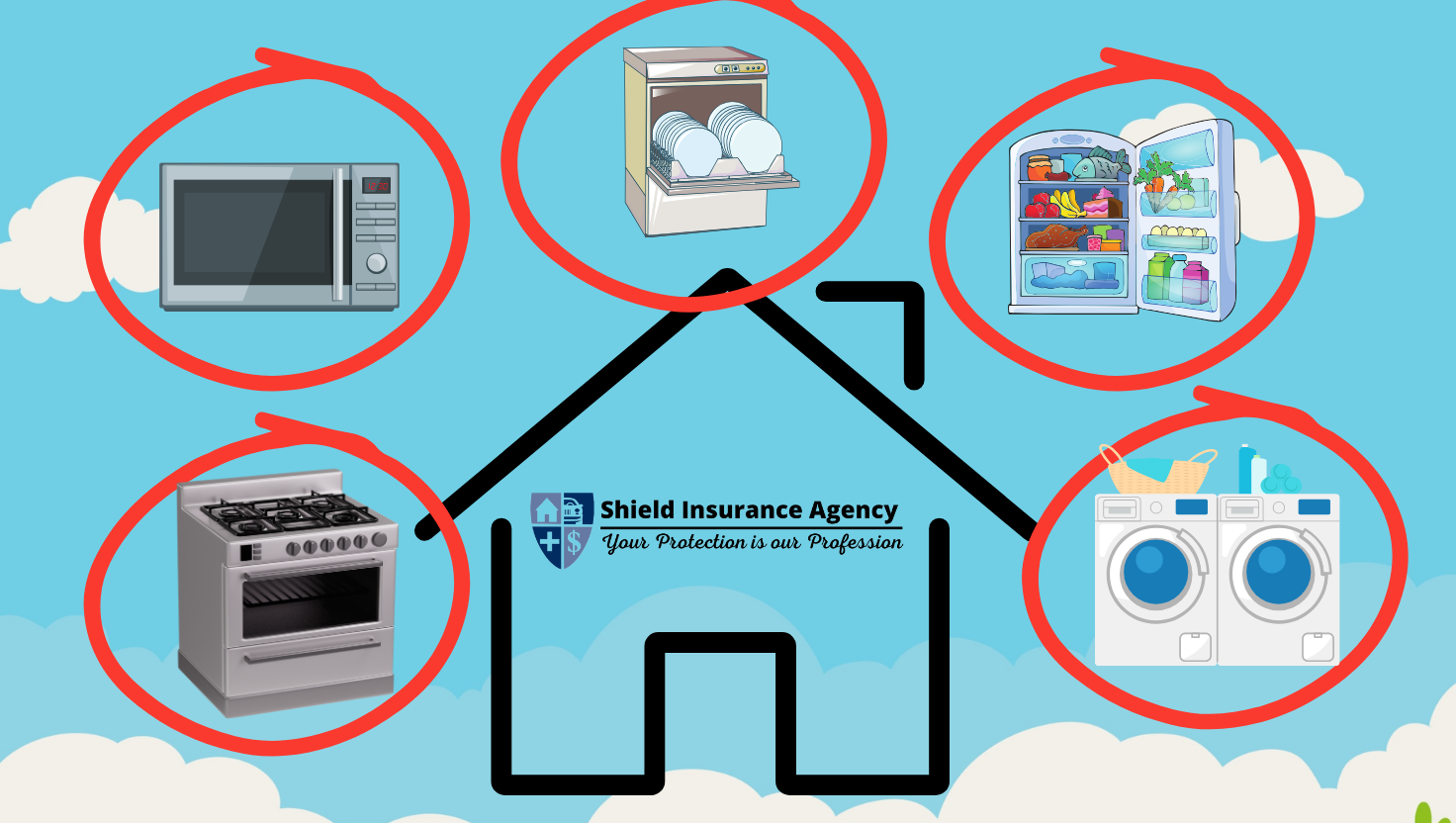
We often overlook our home appliances until there’s an issue — the refrigerator quits, a tree crashes into our A/C unit or an oven is damaged beyond repair in a kitchen fire.

But maybe it’s time we start to take notice. After all, home appliances are some of the hardest working members of our homes, and the cost to replace a home appliance can be significant. An A/C unit, for example, can cost anywhere from $2,000 to $10,000 to replace.

Before an issue arises, take the time to speak with one of our insurance agents and find out when your home appliances are covered by the standard homeowner’s insurance policy. Prepare now so you can more quickly replace your home appliance when you need it most.

When are home appliances covered by a standard Homeowners Insurance policy?

When it applies to your Homeowners Insurance Policy.

All of the home appliances that help keep your home running are typically covered by a standard homeowners’ insurance policy when a peril covered by that policy is the culprit. So, if your oven is destroyed during a kitchen fire or if someone steals your toaster oven during a burglary, those losses would be covered by home insurance.

Appliances that are installed at your home, like your HVAC system, are also typically covered by a standard homeowners’ insurance policy.

Not covered when the issue is caused by age or normal wear and tear.

Similar to other types of insurance coverage, a home appliance would not be covered by a standard homeowners insurance policy if the issue is caused by age or normal wear and tear. Also remember that if you’re renting your home, your landlord is typically responsible for maintaining or replacing any home appliances that came with the property.

If you’re unsure if your home appliance would be covered by your home insurance policy, call or text our office at 616-896-4600 and one of our agents will help you review your home insurance policy and answer any questions you have.


More blog posts by Shield Insurance

Read More

Ladder safety tips everyone should know

Ladder Safety

Ladder Safety. Remember in old cartoons when the main character is caught wobbling at the top of an extension ladder? A funny skit ensues as the ladder inevitably begins to fall and a friend scurries around under an expanding shadow trying to catch them.

Scaling a ladder in real life, we know, is a lot more serious. According to OSHA, portable ladders (step, straight, combination, and extension ladders) are one of the leading causes of falls and injuries to workers on the job. Knowing how to use a ladder properly at home or at work decreases your chances of risk and injury.

From cleaning your gutters to fixing a roof, you’ll most likely need a ladder to get the job done. Keep these ladder safety tips in mind the next time you climb to ensure the job is completed in a safe and timely manner.

Before use

Preparation is key to ladder safety. Keep these tips in mind before you climb:

  • Inspect the ladder for cracked or broken parts such as rungs, steps, side rails and locking components.
  • Be sure all locks on an extension ladder are properly engaged.
  • Do not place ladders on boxes, barrels, tables or other unstable objects to gain additional height.
  • Make sure all tools and materials are securely fastened to the ladder to prevent falling.
  • Do not use a self-supporting ladder, like a step ladder, as a single ladder or in the partially open position.
  • An extension ladder should extend three feet above the point of support.
  • To set your ladder at the right angle, place its base a quarter of the working length of the ladder from the wall or other vertical surface.

  • If using a ladder outside, do not use in windy or inclement weather.
  • Check in with yourself: Avoid using a ladder if you feel dizzy, tired or are impaired.

During use

Ladder safety doesn’t stop on the ground. Keep these tips in mind while your ladder is in use:

  • Do not exceed the maximum load rating of the ladder. Read and follow manufacturer’s labels and warnings for use and weight rating.
  • When climbing, maintain three points of contact through a combination of hands and feet at all times.
  • Don’t stand on the top rung of the ladder unless it’s designed for such activity.
  • Never have someone climb up to bring you something. Only one person should be on a ladder at a time.

  • Don’t move the ladder while it’s in use.

  • Don’t lean or overreach. Reposition the ladder instead.
  • Face the ladder and always grip the rungs, not the side rails.

This article is for informational and suggestion purposes only. To learn more about your insurance needs, contact Shield Insurance Agency.

References:
– Grange Risk Management
– Occupational Safety and Health Administration (OSHA)
– National Safety Council (NSC)

Read More

Homeowners Discount for Insurance

Dependable homeowners insurance shouldn’t have to strain your family’s budget. Nationwide helps you get affordable insurance by offering a range of homeowners discounts. Find out which homeowners insurance discounts you qualify for and start your quote today.

Multi-policy for a Homeowners Discount

Combine and save. Get a discount on home and renters insurance when you bundle your property and auto insurance with Nationwide.

Protective device

Get a discount if your home has smoke detectors, fire alarms, burglar alarms, or other qualifying devices.

Claims-free

You may qualify for a lower premium on your home insurance when you stay claims-free.

Home renovation credit

Get a homeowners insurance discount for renovating your home’s plumbing, heating, cooling, or electrical systems.

Roof rating

Save money based on your roof’s age and surface type.

Home purchase

Receive a discount if you purchased a home within the last 12 months.

Prior insurance

This discount is available to new members and is based on the number of years you were continuously insured by your previous carrier.

Gated community

A discount is available when all vehicle entrances to your community are protected at all times by security guards, residence cards, or key-lock devices.

Read More