
10 areas businesses should address to mitigate professional lines risks in an evolving world

From cybersecurity exposures and ransomware attacks to M&A volatility and securities litigation, a variety of evolving professional lines risks are affecting the management and professional liability market as the economy adapts in response to COVID-19.

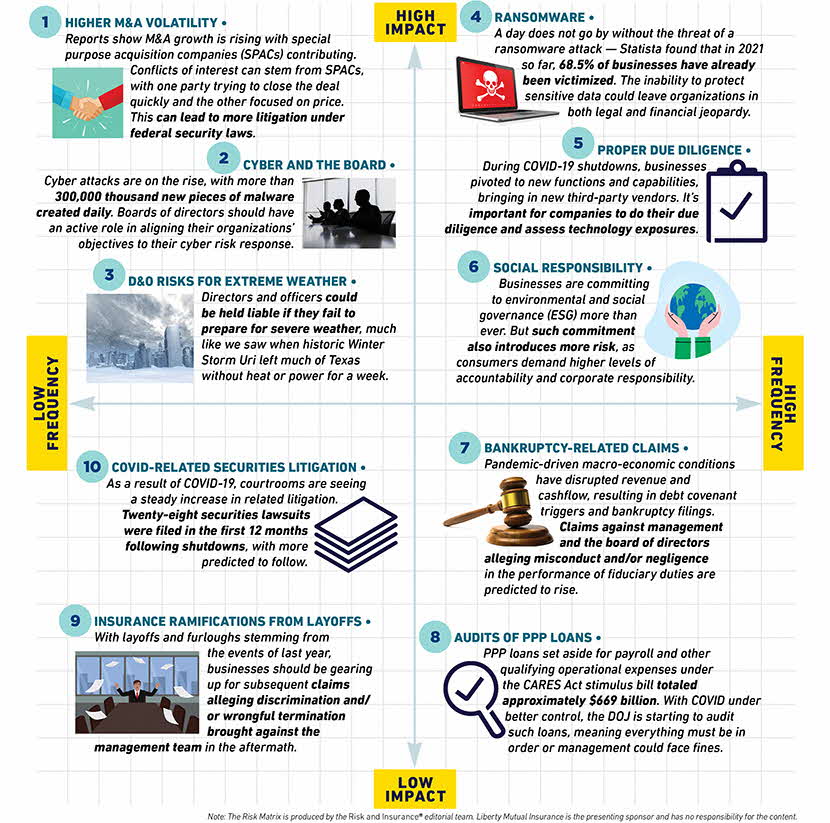
The Professional Lines Risk Matrix featuring 10 potential exposures affecting the professional lines market.

The Risk Matrix, produced by the editorial team at Risk & Insurance®, plots 10 areas that businesses should address to mitigate professional lines-related risks, based on frequency and severity.
10 areas businesses should address to mitigate professional lines risks in an evolving world - Shield Insurance Agency Blog



Download the Risk Matrix

Higher M&A volatility

One pandemic-era risk trend that continues to affect markets is the rise of mergers and acquisitions (M&A). Morgan Stanley reported that last quarter saw 1,250 M&A deals globally, totaling more than $1 trillion. Contributing to the economic landscape are special purpose acquisition companies (SPACs), businesses expressly created to take other companies public and avoid the traditional IPO process. With SPACs, there can be a conflict of interest, with one party trying to close the deal quickly and the other party focused on price. This conflict is leading to more litigation under federal security laws.

Cyber and the board

In 2021 so far, 68.5 percent of businesses have already been victimized by ransomware, according to Statista. And with more than 300,000 new pieces of malware created daily, now is the time for boards of directors to address cyber risk needs. And for good reason: cyber risks are about more than private data; they imperil core operational functions and strategic objectives. It’s never too early to get the board invested in cyber risk management.

D&O risks for extreme weather

Severe weather events can push systems to their limit. When those systems fail, businesses and municipalities may be liable for claims relating to property damage, business interruption, and even loss of life. Directors and officers could be held liable if they fail to prepare for severe weather, much like we saw when historic Winter Storm Uri left portions of Texas without heat or power for a week.  Government and municipalities can mitigate potential directors and officers’ (D&O) exposures by conducting their due diligence. Taking actions like staying up to date on climate data, evaluating and upgrading their current capacities against system failure, and having a continuity plan for emergencies can help organizations reduce their risk and keep the public safe.

Ransomware

The threat of ransomware attacks is becoming more common—in 2021 so far, 68.5 percent of businesses have already been victimized by some type of attack. Digital connectivity is unavoidable for businesses as more turn to computers and online systems to get the job done. The inability to protect sensitive data could leave organizations in both legal and financial jeopardy and goes beyond just cyber exposure. For example, when a ransomware attack occurs at a healthcare facility, both patients and hospital operations can be impacted, resulting in medical malpractice, product liability, and billing errors, and other regulatory liability concerns.

Proper due diligence

For more than a year, businesses across sectors pivoted to new functions and capabilities to keep up with the rapidly evolving economic landscape. While many pandemic-related restrictions are being lifted, the post-COVID-19 world poses a new set of risks that organizations will need to address. Whether companies are welcoming employees back to the office, entering into new vendor partnerships, or evaluating their geographic footprints, they need to do their due diligence and assess the potential exposures.

Social responsibility

Businesses are committing to environmental and social governance (ESG) more than ever before because consumers are looking to engage with corporations that take into account their impact on society at large. How a company treats its employees, addresses top-tier societal issues, and responds to current events can have a significant effect on overall performance. But if a company fails to follow through on its promises, it can expose itself to a variety of risks—loss of shareholders, employees, reputation and revenue can stem from poor ESG performance.

Bankruptcy-related claims

With 2020 going down in history as the “year of COVID-19,” D&O inquiries and related claims continue to be at the forefront of many organizations’ minds. Pandemic-driven macro-economic conditions have disrupted revenue and cash flow, resulting in debt covenant triggers and bankruptcy filings. Boards should be prepared for potential litigation arising out of such actions, and claims made against management alleging misconduct and/or negligence in the performance of fiduciary duties are predicted to rise.

Audits of PPP loans

In response to economic instability caused by the COVID-19 pandemic, Congress passed the Coronavirus Aid, Relief, and Economic Security (CARES) Act. A key part of that act was the Paycheck Protection Program, or PPP, a low-interest loan backed by the Small Business Association (SBA) that would help businesses cover payroll and other operational expenses. As of May 31, 2021, the SBA has given out more than $800 billion in PPP loans. And while most PPP recipients used their loans to stay afloat and support their workforce, some business owners used that money inappropriately. Now, the Department of Justice (DOJ) is beginning to look more closely at how these funds were being used. A business under investigation may look to its D&O insurance policy for support—but it doesn’t necessarily provide coverage in fraud-related government investigations.

Insurance ramifications from layoffs

Click here for the rest of the story


Check out the recent Shield Blogs…

Read More

Why You Can’t Shake Pandemic Fatigue — And What To Do About It

Pandemic Fatigue: How to know if (still) feeling tired is a phase, a funk or something worse

by Beth Howard, AARP, August 10, 2021 | Pandemic Fatigue |

Feeling fatigued during what seems like a never-ending pandemic? Join the club. Whether you feel like you’re languishing or just lacking the energy to head back to the office this fall, you may be one of many Americans who can’t quite shake pandemic-related malaise.

“We’re at home and we’re stressed and the impact of that is to develop a sort of mental and emotional lethargy,” says Margaret Wehrenberg, a clinical psychologist in Saint Charles, Missouri, and author of Pandemic Anxiety: Fear, Stress, and Loss in Traumatic Times.

And yes, your pandemic habits can also play a role — especially if things like regular exercise or healthy eating went out the window sometime during the lockdown. “A lot of people who thought it was going to be a six- or 12-week thing let their diet go,” says Kathryn A. Boling, M.D., a primary care physician at Mercy Medical Center’s Mercy Personal Physicians in Lutherville, Maryland. And instead of, say, going to work and hustling through a commute, “we just walk from the bedroom to the living room and sit in a chair most of the day, except for when we get up to snack.” A year of such habits has likely contributed to the general lassitude. But if you’re over 50 and worried that feeling worn out may just be your new normal, know this: Being tired is not a typical aspect of aging. At least it shouldn’t be when you’re in your 50s, 60s, or 70s. “It does not have to be part of aging until you get pretty advanced,” Boling says. “If you’re 90, you’re more likely to run out of gas.”

Click here for the rest of the story…


Check out the latest posts in Shield Insurance Agency Blog

Read More

4 ways telematics can drive safety for construction companies

In recent years, many construction companies have realized the value of telematics, a method of using phone apps, seatbelt monitors, AI sensors, and cameras to capture information on driving behavior and safety. But while implementing telematics has become increasingly common in construction vehicles, studies show that most companies aren’t embracing the technology to its full potential.

A recent survey showed that while 86 percent of construction companies use telematics, only about 23 percent use that data to inform their decision-making.

The value of telematics data goes beyond safety. It can also offer insight into company-wide trends, reduce operating expenses, and even help in court. Here are four ways that implementing telematics can add value to your construction company—and tips to help construction risk managers and executives act on the data these systems collect.

1. Create a culture of safety for construction companies.

Construction workers face one of the highest rates of injury and death on the job of any profession. The industry accounted for about 20 percent of all on-the-job fatalities in 2019, according to OSHA. As such, creating a culture of safety is a high priority for construction executives, who want to mitigate risk and keep employees safe.

Telematics data enables companies to create that culture of safety—but simply implementing telematics won’t make drivers safer. To make real change, companies need to monitor and coach drivers, with the goal of improving driving behavior and reducing risk.

By leveraging data to change drivers’ habits, companies can take a proactive approach to safety and help stop accidents from happening in the first place. 

Tips for implementation: coach drivers more effectively and respond to trends, not single incident, so employees don’t feel like they are being punished for a situation that may not have been in their control. Focus on positive reinforcement and get to the root cause of poor driving behaviors—like determining whether employees are overworked or fatigued. Liberty Mutual’s Managing Vital Driving Performance (MVDP™) program takes this approach to help companies implement telematics successfully. One customer realized a 56 percent decrease in aggressive driving events and a 60 percent decrease in hard braking events over a three-month time period after implementing MVDP.

2. Reduce operating expenses.

As noted above, telematics data can help your company move from a reactive to a proactive approach to driver safety—and that can make a difference for your bottom line. Why? Safer driving will lead to fewer accidents and less money spent on vehicle repair and replacement. Over time, safe driving can even cut down on regular maintenance costs because drivers won’t wear out brakes and other parts as frequently. Additional savings might include improved fuel efficiency and better regulatory compliance—which means lower fuel costs and fewer DOT citations to pay.

Tips for implementation: bring telematics into your asset-management process by monitoring costs like maintenance, citations, and other expenses each quarter. You can then compare these expenses to telematics data to track how safe driving is impacting your operating costs.

For larger companies, in particular, telematics is a valuable investment as it can help you spot trends across your fleet. A national construction company, for example, might use telematics to monitor driving behavior across geographic regions to determine whether certain areas are more prone to risk. Telematics data can also help you track trends across different employee populations, types of vehicles, and more. These trends can help you assess your risks from all aggressive driving—not just aggressive driving that has resulted in a single accident.

Tips for implementation: for companies with a large fleet, telematics data analysis should be part of a robust fleet safety program that includes pre-hiring screenings, crash reporting protocols, and more. 

Click here for the rest of the story…


Check out other Shield Insurance Agency Blogs

Read More

PFAS: the extraordinarily costly liability you need to know about

A new and massively costly complication is changing environmental liability: cleanup of hazardous per- and polyfluoroalkyl substances (PFAS) found in aqueous film-forming foams or AFFFs. Commonly used throughout the United States, these Class B firefighting foams are used to extinguish fires involving flammable and combustible liquids, oils, gases, and more. PFAS are held to some of the toughest cleanup standards among regulated contaminants. To make matters more challenging, there are few technologies proven to do the job – and many associated costs.

Cleanup costs of PFAS compounds in AFFF can be 5 to 20 times more than those of fuels released from a petroleum storage facility.1

What creates such high costs?

PFAS waste is managed by waste disposal companies as federal hazardous waste. Disposal costs are often nearly double the typical cost of disposal of petroleum-impacted waste. There are several factors at work here:

  • Limited soil treatment options. The only proven methods for treating PFAS in soil are excavation followed by landfill disposal or destruction via incinerator – both of which are costlier than methods used to dispose of other contaminants. 
  • Limited soil treatment resources. Because of the potential for extraordinary liability, only a limited number of landfills and incinerators accept PFAS waste.
  • High transport costs. With facilities few and far between, transporting PFAS-impacted soil can be four times higher than transporting petroleum-impacted waste.1
  • Limited groundwater treatment options. Only ex-situ technologies that include groundwater extraction wells and above-groundwater treatment systems with granular activated carbon or ion exchange resins are proven to treat PFAS in groundwater.
  • Long-term groundwater costs. A groundwater extraction and treatment system may need to operate for as long as 40 years, entailing significant operation and maintenance costs. 
  • Strict federal standards. The acceptable rate of PFAS is notably low, requiring a greater effort and more funds to achieve.

Breaking down cleanup costs

This outline of cleanup costs associated with PFAS contamination following a typical energy industry fuel fire shows the considerable scope of this threat.

$2.25M
Collection and disposal of 1M gallons of AFFF, water, and fuel at hazardous waste management facility

$12M to $54M
The projected cost for soil cleanup

$10M to $15M
The projected cost for groundwater cleanup

$1.8M
One year of stormwater runoff management (collection, transport, and disposal of 800,000 gallons of runoff at hazardous waste management facility)

TOTAL COSTS
$26.05M to $73.05M

How can vulnerable companies prepare?

Click here for the rest of the story…


Check out other Shield Insurance Blog Posts

Read More

Personal vehicles and business liability: what risk managers need to know

If you’re a risk manager, safety officer, or a company stakeholder, you know the business liability exposure for company vehicles inside and out. You regulate and maintain your fleet and your drivers daily, and do everything you can to avoid being part of the more than 7 million auto accidents that occur in the U.S. every year.

But your liability may not end with your company fleet. If your business allows employees to use personal vehicles to conduct business, even only occasionally, you might be exposing your company to additional risk. Here are six areas to consider so your company can mitigate risk and better protect your employees and company.

1. Establish hiring guidelines

Limiting your company’s liability begins with establishing clear hiring practices. Just as you would for employees driving company vehicles, make sure employees who will drive personal vehicles on the job have valid driver’s licenses. For every driver, obtain a motor vehicle record (MVR) to review accidents, infringements, and other behind-the-wheel behaviors. Evaluate MVRs annually and confirm that all employees driving personal cars continue to maintain good driving records. If employees are found exhibiting unsafe behaviors, take whatever measures you feel are appropriate—including training, suspension, or even dismissal.

2. Clarify expectations for drivers

Require employees who are driving personal automobiles for business purposes to sign vehicle use agreements. This document should describe your expectations for employees while they are behind the wheel. For example, employees should agree to:

  • Abide by all state and local laws and regulations pertaining to vehicle operation;
  • Refrain from activities that could lead to distracted driving, including the use of mobile phones; and
  • Never consume alcohol or illicit substances during work hours.

The consequences for disobeying the agreement’s guidelines should be outlined as well. And remember to review and update these agreements regularly—and then obtain new signatures after staff review the revised agreement.

3. Evaluate liability coverage

Your business should also set standards for employees’ automobile liability coverage. In general, state coverage requirements are typically low. California, for example, only requires $5,000 coverage for property damages, while other states only require $10,000 to $15,000 coverage for bodily injury. But a serious accident, resulting in disabling injuries or fatalities, can result in claims costs in the millions.

Your insurance carrier and broker can help recommend minimum coverage requirements and also suggest changes to your company’s commercial auto coverage based on your potential exposure. Employees who use their personal vehicles for work frequently may also want to consider adding business use endorsements to their personal automobile policies. Maintain copies of employees’ certificates of insurance detailing coverage periods and limits and request updated copies every year.

4. Require regular vehicle maintenance

Click here for the rest of the story…

Have you seen our recent posts?

Read More

National Hispanic Heritage Month

National Hispanic Heritage Month from September 15 to October 15

source: Hispanic Heritage Month | Shield Insurance Home

About National Hispanic Heritage Month

Each year, Americans observe National Hispanic Heritage Month from September 15 to October 15, by celebrating the histories, cultures, and contributions of American citizens whose ancestors came from Spain, Mexico, the Caribbean, and Central and South America.

The observation started in 1968 as Hispanic Heritage Week under President Lyndon Johnson and was expanded by President Ronald Reagan in 1988 to cover a 30-day period starting on September 15 and ending on October 15. It was enacted into law on August 17, 1988, on the approval of Public Law 100-402.

The day of September 15 is significant because it is the anniversary of independence for Latin American countries Costa Rica, El Salvador, Guatemala, Honduras, and Nicaragua. In addition, Mexico and Chile celebrate their independence days on September 16 and September 18, respectively. Also, Columbus Day or Día de la Raza, which is October 12, falls within this 30 day period.

Click here for the rest of the story…

Check Out Shield Insurance Recent Blog Posts

Read More
Shield Insurance Agency - Types of insurance and the insurance companies Shield is proud to represent

Shield Insurance Agency Product List

Shield Insurance Agency | Start A Quote Today!

Types of Insurance Shield Insurance Agency Provides

Shield Insurance Agency has been in business for so many years, we can shop a lot of different companies for a lot of different types of insurance to be sure you get what you need for the price you can afford. Check out the list!

Personal

  • Auto Insurance
  • Boat Insurance
  • Condo Insurance
  • Dental Insurance
  • Disability Insurance
  • Event Insurance
  • Farm Insurance
  • Flood Insurance
  • Health Insurance
  • Homeowners Insurance
  • Mobile Homeowners Insurance
  • Motorcycle Insurance
  • Motorhome Insurance
  • Recreational Vehicle Insurance
  • Renter Insurance
  • Term Life Insurance

Business

  • Auto Facilities
  • Bond Insurance
  • Business Interruption
  • Cannabusiness
  • Church Insurance
  • Commercial Auto
  • Commercial Property Insurance
  • Contractor Insurance
  • Cyber Liability Insurance
  • General Liability Insurance
  • Group Health Insurance
  • Group Life Insurance
  • Liability Insurance
  • Professional Liability Insurance
  • Security Bond Insurance
  • Workers Compensation

Insurance Companies Shield Insurance Agency is Proud to Represent

AAA
Accident Fund
Aegis
Ambetter
American Modern
ASI
Assurity
Berkshire Hathaway GUARD
Berkshire Hathaway Homestate
Blue Cross Blue Shield/BCN
Bristol West
Companion Life
Conifer
Delta Dental

Foremost
Freemont
Genworth
Golden Rule
Grange
Hanover
HAP
Hiscox
Humana
ING
Liberty Mutual
Liberty Union
Medishare
Molina Healthcare
National General
Nationwide

North American Company
Philadelphia
Principal Financial Group
Priority Health
Progressive
Reinsurepro
RLI
Safeco
State Auto
Superior Flood
The Hartford
Transamerica
Travelers
United Healthcare
Unum
Wolverine


Check out Shield Insurance Agency Recent Blogs…

Read More

When Disaster Strikes: What to Put in Your Medication Go Bag

Atlantic hurricane season is a good reminder that everyone should prepare this potentially lifesaving kit

By Consumer Reports Last updated: July 05, 2021

A well-stocked Medication Go Bag can be used to soothe a cut or burn—or to save your life during a hurricane, flood, fire, or other emergencies.  

But it’s important not to wait until you’re faced with the need to leave your home in a hurry to assemble your medication go bag, says Geoffrey C. Wall, Pharm.D., a professor of pharmacy practice at Drake University in Des Moines, Iowa.

Whether you buy a kit from a drugstore or build it yourself, Wall recommends that all households keep a medication go bag on hand. It should contain the essentials, including: 

  • At least seven days’ worth of over-the-counter and prescription medications you take on a regular basis. Label the containers clearly, and include a printed-out list of everything you take and the regimen for each medication, plus a copy of your health insurance card (in case you need medical care while you’re away from your home).
  • An antihistamine for allergic reactions, such as diphenhydramine (Benadryl Allergy and generic) or loratadine (Claritin and generic).
  • Pain relievers, including acetaminophen (Tylenol and generic), aspirin, ibuprofen (Advil, Motrin IB, and generic), or naproxen (Aleve and generic).
  • Stomach and antidiarrheal remedies, including loperamide (Imodium and generic) and bismuth subsalicylate (Kaopectate, Pepto-Bismol, and generic).
  • An antacid for heartburn, such as Maalox, Mylanta, Rolaids, Tums, or generic.
  • Antiseptic wipes; an antibiotic ointment such as Neosporin, Bacitracin Plus, Curad, or generic (use only for infected wounds); and bandages, gauze, and tape, for treating burns, cuts, and wounds.
  • Mosquito repellent to prevent bites, and aloe gel, hydrocortisone cream, or calamine lotion to soothe bites and skin irritation.
  • An eyewash solution for flushing out eye irritants.
  • Water-purification tablets.
  • Scissors.
  • Thermometer.
  • Tweezers.

If you and your family have special medical needs, you can build a more sophisticated medication go bag—for example, one that contains hearing aids with extra batteries, an epinephrine auto-injector, glasses, contact lenses, or syringes.

Fill Prescriptions in Advance

For prescriptions, you and your family members take, consider asking your doctor for 60- or 90-day refills rather than a month’s worth. That way, you’re more likely to have extras on hand for your medication go bag. (This can also save you money.)

Always fill prescriptions on the first day you become eligible for a refill, rather than waiting until the day you run out. If you are able to obtain an emergency supply, establish a plan for rotating your go-bag supply so that it remains up to date. And remember to check medications periodically to ensure that they have not expired.

“During an emergency, some states allow pharmacists to dispense an emergency supply of medications without doctor authorization,” Wall says. But, he adds, “certainly if a known potential disaster, such as a hurricane, is predicted, make sure you have prescription meds and supplies before it hits.”

You might also ask your health insurance company to assist you in obtaining enough medication and supplies to have on hand.

Storing and Maintaining Your Kit

Click here for the rest of the story…


More great articles!

Read More

Surety bonds reach the tech market: 5 new things to know about bonding your tech firm

Just 15 or 20 years ago, tech companies had reputations for rapid business cycles and increased risk, making surety bonds for technology-related contracts difficult to obtain. But in recent years, the playing field has changed drastically, with financial experts feeling more confident in tech investment now that technology is a foundational part of our world. Despite these market changes, many technology companies still fall into the old routine of utilizing letters of credit or posting collateral to guarantee their performance. For companies looking to move away from old methods, bonds are an attractive alternative for many reasons: they aren’t credited on the company’s bank line, are not typically listed as contingent liabilities in corporate financial statements, and usually provide a more robust defense against default.

Bottom line? The surety process is no longer out of reach for tech companies. If your company is considering a surety bond, here are five things you should know before you start the process.

1. Understand your options.

Surety in the tech sector is still an emerging market, meaning many risk managers simply don’t know what options are available. There are a variety of bonds that are relevant for the tech industry, however. For example, lease and utility payment bonds can help secure commercial space to expand your operations, while worker’s compensation, customs, and tax bonds cover dues owed to employees and government entities. Tech companies may also apply for court bonds to cover legal expenses and appeals. This concern is becoming increasingly important as big tech companies and startups alike face legal action for privacy breaches, anti-trust activity, and more. 

2. Consider a performance bond.

Click here for the rest of the story…


More great articles!

Read More

5 trends disrupting the wholesale industry: digitization, and more:

Wholesale Industry | Shield Insurance Blog | Start A Quote Today!

For decades, wholesale distributors have been the primary source of inventory to retailers. Over the past decade, however, technology, e-commerce, and shifting customer expectations have altered the wholesale landscape. Today’s distributors are evolving their business models—and fast.

In this article, we’re diving into five trends disrupting the wholesale industry, from navigating competition like e-commerce giants to embracing technological innovation.

1. Digitization and the wholesale industry

With access to a massive catalog of products that they can ship quicker than most competitors, digital giants like Amazon and Alibaba have sent shockwaves through the traditional wholesale industry. This threat is particularly serious when it comes to commoditized products like printing supplies and paper. The problem? Businesses are looking for the fastest, easiest, and most affordable way to obtain these products—and traditional wholesalers often struggle to keep up with their digital competitors.  

In 2017, 92 percent of wholesale distributors cited Amazon as a competitor—and for good reason. According to a recent report from the National Association of Wholesaler-Distributors (NAW), Bank of America/Merrill Lynch estimates that Amazon Business, the tech giant’s wholesale branch, will reach $34 billion in gross merchandise sales by 2023, and $125 to $245 billion by 2029. And Amazon and Alibaba aren’t the only competitors in the digital space—new business models are constantly emerging, including eBay Business & Industrial, Digi-Key, and Zoro. With all these businesses competing for the same pool of customers, their profits will likely come at the expense of traditional distributors.

2. Disintermediation

As digitization continues to connect more people and systems, it creates an opportunity for manufacturers and retailers to skip traditional wholesalers and work directly together, blurring the line between wholesale, retail, and manufacturing. As a result, disintermediation has become more common in the marketplace. The number of direct-to-consumer (D2C) brands is projected to grow by almost 20 percent in 2021, with many manufacturers leveraging e-commerce platforms to bypass wholesalers entirely. For example, Boeing invested heavily in business-to-business (B2B) e-commerce and acquired a leading aerospace parts distributor, helping increase its share of the replacement aerospace parts market by 7 percent. Many companies find that they can also improve shipping speeds and customer service by cutting out the middleman role that wholesalers traditionally play.

3. Evolving customer demand

Click here for the rest of the story on the Wholesale Industry


More great reads!

Read More