
layoffs and hiring freezes

The tech industry’s moment of reckoning: layoffs and hiring freezes

The Verge | By VERGE STAFF | Jan 26, 2023 | layoffs and hiring freezes | Business Insurance with Shield

Over the past few months, the economy has started to turn, and tech workers are being hit hard. Meta, Twitter, and more have fired thousands, and others are slowing or freezing hiring.

Over the last year, it feels like every day, we’ve heard the news of mass layoffs and hiring freezes from big tech companies that were formerly famous for having deep pockets and near-endless amenities for workers.

Now, it’s clear that the industry as a whole is tightening its belt, leaving hundreds of thousands of employees out of work — and more wondering if they’ll have a job within the next few months or searching for jobs in an industry that no longer has a spot for them. It’s gotten to the point where one tech recruiting site created an interactive tool to track the layoffs across established companies and startups.

To open 2023, Amazon announced layoffs of mostly corporate employees will trim 18,000 workers from the roster, the biggest reduction — in raw numbers, despite Amazon’s 1.5 million-strong workforce — yet. Slightly smaller raw numbers popped up at Google, with 12,000 layoffs, and Microsoft, with 10,000.

Elizabeth Lopatto spoke to experts to try and answer the question of why so many layoffs are happening right now, despite tech companies continuing to register sizable profits. One reason is that “investors have changed how they’re evaluating companies,” even if there’s a lack of evidence that the layoffs can help solve any of the problems they may have.

Twitter’s layoffs happened because Elon Musk bought the company and took it private, and Meta’s CEO claims its 13 percent reduction in staff is a course correction after the company went on a hiring spree during the online retail boom that came out of the pandemic. Companies that rely on advertising, like Meta and Snap, have also been hit hard by privacy policy changes from Apple.


Meanwhile, the iPhone maker is blaming the economy for its own hiring slowdown, despite being one of the few companies still announcing record-breaking earnings and beating estimates.

We’ll probably see even more reasons for layoffs or freezes as other companies announce their own. Stay tuned to this page for the latest on big tech companies’ cost-cutting measures and how they affect current and former employees.

Here’s all our coverage of the recent outbreak of layoffs and hiring freezes from big tech, auto, crypto, and more:

Read more on layoffs and hiring...


More great blogs by Shield Insurance Agency

Read More
How to reverse burnout at work

Balance these 6 things to reverse burnout at work, says social psychologist and author of ‘The Burnout Challenge’

CNBC.com | Renée Onque@IAMRENEEONQUE | Nov 14 2022 | Burnout | Business Insurance

Do you struggle to pinpoint why you’re burnt out at work? Is it you? Is it your job?

It may actually be a mismatch of the two, according to Christina Maslach, a social psychologist, retired professor of psychology at U.C. Berkeley and author of “The Burnout Challenge: Managing People’s Relationships with Their Jobs.” 

“You really have to look at the relationship with the job, and that means looking at both the job and the person. It’s not like one or the other,” Maslach tells CNBC Make It.

“It’s certainly not just the person who has to make the changes.”

The cure for burnout isn’t just taking time off or a starting a mindful morning routine, but it’s actually discovering how to get a better match between what your job requires of you and the tools you have to complete your duties, she says.

Maslach, and co-author of her book, Michael P. Leiter, identified six areas within your profession that should meet your standards, or else your risk of more stress and potential burnout increases.

Here are the six factors and how they may be affecting you.

Workload Burnout

It can be extremely difficult to meet high demands when you’re low on resources, says Maslach.

Lacking supportive tools like time, people, equipment or information may be affecting your ability to do your job how you’d like to.

Control

Having autonomy, discretion and an ability to make choices are necessary in the workplace in order to feel like you’re doing your job well, she notes.

“People often complain about having a lack of control, that they’re told what to do, no ifs, ands or buts about it,” she says.

Reward

The way you feel about your salary and benefits can influence your emotions toward work. But, rewards aren’t just limited to finances.

“A lot of times, it’s social recognition, that people are pleased by what you’ve done and let you know it,” Maslach says. If you’re working hard and aren’t receiving positive feedback, you’re more likely to feel unjustified.

Community Burnout

From co-workers, bosses, and people you supervise to clients, patients, or students, everyone you interact with while working can affect your feelings about your job. Without mutual respect, trust, and support within your team, even the best job can turn into a “socially toxic workplace” that you hate, says Maslach.

Fairness

“Where there’s an absence of fairness, this is where discrimination lives. This is where glass ceilings exist,” Maslach says.

Rules, policies and practices should feel equal in your work environment or it can lead to resentment, she adds. You need to believe that you have an equal chance at receiving promotions and just as many opportunities as the rest of your team.

Values

You’re a lot more likely to quit your job if it doesn’t align with your basic moral principles, says Maslach.

Working for a company or organization where there are ethical conflicts can deter you from feeling enthusiastic about what you do, she notes.

How to approach an imbalance in these areas

More on Reverse Burnout at work…


More great articles from Shield Insurance Agency

Read More
Economic uncertainty and risk management resilience in 2023: 3 trends to watch

Economic uncertainty and risk management resilience in 2023: 3 trends to watch

Liberty Mutual | 01/06/2023 | risk management | Business Insurance

Organizations across the country face uncertainty and tough choices as economists continue to paint a gloomy picture of an impending recession.

“We’ve never experienced inflation, recession, pandemic, supply chain issues, social inflation, and labor shortage — all converging at the same time,” notes Matthew Moore, executive vice president and president of underwriting for Liberty Mutual Global Risk Solutions.

We’ve never experienced inflation, recession, pandemic, supply chain issues, social inflation, and labor shortage — all converging at the same time.

-Matthew Moore, EVP and president of underwriting for Liberty Mutual GRS

In a landscape of turbulence, how can companies effectively forecast their futures? What tools can they use to engineer resilience and reanalyze risk?

According to Moore, proactive risk-management planning, and the help of strategic partnerships with insurance providers, offer a way forward.

“Insurance can offer real solutions,” says Moore. “You need to work together with your carrier to develop smart solutions that strategically manage and mitigate risk.”

Three risk management trends to watch in 2023

In this time of uncertainty, here are three risk-management trends to look out for, along with why partnering closely with insurance providers can help companies build a roadmap for resilience.

Companies’ risk management profiles will likely shift.

For corporate risk managers, a critical takeaway is that economic turbulence has likely shifted your company’s risk profile — leaving many organizations at risk of being underinsured. As businesses may be tempted to reduce costs by cutting corners on risk mitigation, loss controls, workforce safety, good governance, and compliance, insurance providers will be keeping a close eye on risk profiles.

Property valuations are another factor impacting risk profiles. “Inflation, labor shortages, and supply chain issues all are driving property-replacement costs that are out of sync with valuations,” Moore says. In fact, Liberty Mutual’s experts estimate that a whopping 75 percent of commercial businesses are undervalued. For example, because of rising costs, a building valued at $1 million five years ago could easily cost 20 percent more to replace today. There are also other factors beyond construction costs, including the frequency and severity of weather activity and business interruption, that should be considered.

If you’re underinsured, Moore notes, “you may face another unpleasant surprise after you’ve already experienced a loss.”

Working together with your provider and broker, proactively, is the best way to help ensure your operations have the right coverage and can recover quickly after a loss.

Insurance carriers may become more selective in response to economic disruption.

It’s not just insured businesses who are carefully navigating change — insurance carriers are also feeling economic pressure. Working to stifle inflation, the Fed raised rates for the seventh time this past December, this time by 0.5 percent. With so much rapid change, insurance carriers are rethinking their business strategies.

“Commercial insurance lines can face an amplified impact, as exposure bases like payroll or sales can decline quickly, reducing premium and increasing risk,” says Moore.

As the economy slows, carriers expect a decreased demand for insurance and, consequently, a decrease in premium pricing. While carriers’ investment income might increase, their tolerance for risk may weaken. Carriers could, for example, reduce their capacity in some industries and lines based on market cycle vulnerabilities.

The potential for carriers to become more selective highlights the importance for companies to communicate any business changes — both within their organization and to their insurance partners — to mitigate any unexpected changes

Value-add insurance offerings play an even more important role in managing the total cost of risk.

Read More…


More blogs by Shield Insurance

Read More
Why cybersecurity leaders are actively recruiting neurodiverse talent

Why cybersecurity leaders are actively recruiting neurodiverse talent

 Worklife News   | BY OLIVER PICKUP | JANUARY 10, 2023 | Cybersecurity | Cyber Liability Insurance

In an attempt to clamp down harder on the increased risk of cybersecurity threats to businesses, tech leaders are actively hiring neurodivergent people because of the strong problem-solving and analytical skills they can offer.

The neurodiversity spectrum is wide, ranging from attention deficit hyperactivity disorder (ADHD), dyslexia, dyspraxia, and Tourette syndrome, to autism and bipolarity. But common characteristics of neurodivergent individuals – including pattern-spotting, creative insights, and visual-spatial thinking – are finally being realized, not least in the cyber security sector.

Holly Foxcroft, head of neurodiversity in cyber research and consulting at professional search firm London-centered Stott and May Consulting, said that neurodivergent individuals have “spiky profiles.” Foxcroft, who is neurodivergent herself, explained that these visual representations highlight the strengths and areas needed for development or support. “Neurodivergent profiles show that individuals perform highly in areas where neurotypicals have a consistent and moderate line,” she said. 

The areas in which neurodivergent individuals have “exceeded skill” include high-level problem-solving, creative “out-the-box” thinking, hyper-focusing, and pattern spotting. “These are much-needed attributes and skills in cybersecurity,” added Foxcroft.

Unique skills for unknown unknowns

Perry Carpenter, chief evangelist and strategy officer at KnowBe4, a global cybersecurity awareness platform, said: “As someone on the autism spectrum, I’m very encouraged by the efforts of the security community to recruit neurodivergent employees actively.” 

The resident of Little Rock, Arkansas, is proud his work community is leading the way. He said these recruitment efforts mark an essential step in helping to overcome some of the ”inherent stigmas” associated with neurodivergence. However, Carpenter also warned against yet more generalizing “Just because someone is neurodiverse doesn’t mean that they will naturally be great coders or analysts. We don’t want to create new stereotypes.”

“Our adversaries [cybercriminals] are not universally neurotypical, so it makes sense for us to have a defensive force that is also diverse and representative of their thinking patterns and skillsets.”

Perry Carpenter, chief evangelist and strategy officer at KnowBe4.

KnowBe4’s Carpenter listed the main reasons cybersecurity leaders are “actively recruiting” neurodivergent staff. First, the community understands more than most that “unique individuals” can offer “unique skills” suited to cybersecurity. Different ways of thinking are critical in the fight against cybercriminals, who also know the benefits of employing innovators. “Our adversaries are not universally neurotypical, so it makes sense for us to have a defensive force that is also diverse and representative of their thinking patterns and skillsets,” said Carpenter. 

Whether “hyper-focused” or offering out-of-the-box thinking, neurodivergent workers enable “teams to continually grind data, identify patterns, or find solutions to complex problems that someone else might miss,” according to Carpenter.

Paul Baird, the chief technical security officer in the U.K. for cybersecurity firm Qualys, built on this theme. “If you have a neurodiverse team, they will react differently when a problem arises,” he said. “The alternative is that you have a cookie-cutter approach to security where every problem gets handled the same way each time.” 

The latter strategy struggles with unknown unknowns or unexpected events. “At that point, you need people with multiple views and backgrounds to solve these problems effectively,” Baird added.

Narrowing the cybersecurity skills gap

Read the full story here…

Read More
5 ways to get the most out of your small business’s health insurance plan - Shield Insurance Blog

5 ways to get the most out of your small business’s health insurance plan

The Business Journals | By Cigna + Oscar | Oct 25, 2022 | Health Insurance

Whether you’ve just purchased small business health insurance or you’re shopping around, you’re probably aware that coverage can be costly, depending on the plan you purchase. According to a 2021 Kaiser Family Foundation report, the average annual premium was $7,739 for an individual and $22,221 for a family plan. Employers helped cover 83% of the costs for a single person and 63% of a family plan.

That’s why it’s critical to make the most of the plan you have — and help your employees stay engaged. Here are five key ways you can maximize your health insurance coverage, so your employees use the plan often, become healthier and help lower your business’s costs.

1. Emphasize the health insurance plan’s customer support programs and tools.

Some health plans offer dedicated customer support, online tools, and even concierge-like services that can help employees understand and use their plan. For example, Cigna + Oscar is unique in that it offers Care Guides, a team of professionals who help members find doctors and answer their questions about specific benefits and claims. Care Guides can also help coordinate care and prepare members for their upcoming procedures.

The more employees understand how their plan works, the more likely they are to use in-network providers, purchase generic medications, and rely on other cost-saving methods. In turn, this can help you, as an employer, lower your overall costs too.

2. Encourage your employees to manage their health insurance plan digitally.

If your health plan offers a mobile app, it may be where employees can access telemedicine services and prescription refill requests and even pay their premiums online. Encourage them to make the most of these convenient, digital services. After all, they help make your business’s health plan easy to use and can increase employee satisfaction.

If you’re shopping for a health plan now, look for one that offers digital services. You may want to ask your broker:

  • What telemedicine services are available to my employees, if any?
  • Is virtual urgent care available?
  • Can employees request prescription refills online?
  • Is there an easy way for employees to search if a doctor is in-network?
  • What other digital services are available with this health plan?

The bottom line: Today’s employees want to manage their healthcare at the click of a button. A convenient and easy-to-use mobile app and website can help them do that.

3. Communicate to employees about mental health care offerings.

Click here for the full story…


Find more great blogs from Shield Insurance Agency

Read More
Workplace Stress

Back to Basics: Workplace Stress

BLR | By Grace Hatfield, EHS Daily Advisor | Jan 9, 2023 | Workplace Stress | Business Insurance

Back to Basics is a weekly feature that highlights important but possibly overlooked information that any EHS professional should know. This week, we examine workplace stress and OSHA’s recommendations for addressing mental health.

Workplace Stress impacts the health and mental wellbeing of employees in every industry. According to OSHA, mental health challenges can include clinical mental illness, substance use disorders, and emotions like stress, grief, and feeling sad and anxious, even when these feelings are temporary and not part of a diagnosable condition. Even though workplaces can induce stress, they can also provide resources, solutions, and activities to help improve mental wellbeing.

Scope of the Workplace Stress Problem

OSHA says that workplace stress and poor mental health can negatively affect workers through job performance, productivity, work engagement and communication, physical capability, and daily functioning. More than 80% of U.S. workers have reported experiencing workplace stress, and more than 50% believe their work-related stress impacts their life at home. Workplace stressors can include the following:

  • Concerns about job security
  • Lack of access to tools and equipment needed to perform work safely
  • Fear of employer retaliation
  • Facing confrontation from customers, patients, coworkers, supervisors, or employees
  • Adapting to new or different workspaces, schedules, or rules
  • Having to learn new or different tasks or take on more responsibilities
  • Having to work more frequent or extended shifts
  • Being unable to take adequate breaks
  • Physically demanding work
  • Learning new communication tools and dealing with technical difficulties
  • Blurring of work-life boundaries, making it hard to disconnect from the office
  • Finding ways to work while simultaneously caregiving
  • Concerns about work performance and productivity
  • Concerns about the safety of using public transit to commute

These stressors can negatively affect a person’s mental health and sense of well-being, which can potentially contribute to serious problems, like the development or exacerbation of mental health challenges. Stressors can also lead to issues with productivity, happiness, and burnout.

Employer guidance and Workplace Stress

The goal should be to find ways to alleviate or remove stressors in the workplace to the greatest extent possible, says OSHA, and to build coping and resiliency supports, and ensure that people who need help know where to find it. Reducing workplace stress can improve morale and lead to increased productivity, better focus, fewer workplace injuries, fewer sick days, and improved physical health.

There are four key things that employers can do to help their workers manage and reduce stress. The first is to be aware and acknowledge that people can carry an emotional load that is unique to their own circumstances. Some people may experience heightened levels of loneliness, isolation, uncertainty, grief, and stress, while others may have additional responsibilities like caregiving for children or elderly household members. There are also those who already have existing mental health and substance use challenges.

Employers should identify factors that are making it harder for workers to get their jobs done, and determine if adjustments can be made. Leaders must also show empathy, by ensuring their employees that they are not alone, their employer understands the stress they are under, there is no shame in feeling anxious, and that asking for help is important.

The last key factor is providing access to coping and resiliency resources, workplace and leave flexibilities without penalty, or other supportive networks and services. OSHA says that research from the American Psychological Association suggests that 50% of employees find that a lack of paid time off or sick leave has a negative impact on workplace stress levels.

OSHA provides recommendations for senior managers and supervisors on how to get conversations started with employees about mental health. Senior managers should be transparent and avoid using negative or stigmatizing language when discussing mental health and workplace stress. They should stay positive and speak positively around everyone, and listen without judgment if a staff member reaches out.

Managers must be understanding and offer assistance, and model exemplary behaviors by demonstrating self-care behaviors. Lastly, they should adequately train frontline supervisors about mental health issues, so they have the skills and confidence to address these issues and recognize the signs and symptoms of emotional distress.

As for supervisors, they should find out if workers need help, and look for ways to redistribute tasks to minimize stress. They must monitor their own stress levels and make sure that they are taking care of themselves. Supervisors should be compassionate and understanding and look for signs of stress and mental health emergencies.

If there is concern about a worker experiencing a serious mental health or substance use challenge, encourage them to get help. Lastly, supervisors must know the facts, and OSHA recommends that they take training to learn about mental health issues.

Training with Workplace Stress

Learn more about workplace stress…


More great blog articles shared by Shield Insurance Agency

Read More
6 Money Habits to Break in 2023

6 Money Habits to Break in 2023

Get off to a good start by stopping some common (bad) money habits.

AARP | By Karen Hube | December 12, 2022 | Money Habits | Shield Insurance Quoting Portal

You may not be able to do anything about big problems afflicting the economy and the stock market, but little changes to your everyday activities can help shore up your financial security. Consider the following six routines — and why you should ditch them in 2023 for better money habits.

1. Constantly checking your portfolio’s value

During rocky times in the market, it’s natural to want to know how your investments are holding up. But the more often you check, the wider you open the door to counterproductive emotions. Exuberance can fuel overconfidence and unwise risk-taking, while fear of loss can drive you to yank money out of stocks and miss out on future returns, says Chris Orestis, president of Retirement Genius, a financial planning website. Either way, you impair your portfolio’s long-term growth potential.

HOW TO BREAK THE MONEY HABITS

Keep in mind that short-term ups and downs are a package deal when you invest in stocks, but over time the stock market has recovered from declines and resumed climbing. In the past 42 years through 2021, the S&P 500 had intra-year declines in every year averaging negative 14 percent, with dips of 10 percent or more in 23 years, according to Fidelity. But the index ended in positive territory in 35 years, and the average annual return has been around 14 percent.

2. Downplaying the risk of cybercrime

You might think cybertheft will never happen to you, but the older you are, the more likely you are to be a target. Cyber­criminals stole nearly $3 billion from people 50 and older in 2021 — more than all younger age groups combined — according to the FBI. The most common tactic is to entice people into providing personal data by phone or email, or into clicking on seemingly innocent links that let criminals access information on a target’s computer. Paul Tracey, CEO of Innovative Technologies, a cybersecurity company, says scammers have been getting increasingly sophisticated. They commonly pose as employees of familiar companies and drop personal details about you that make them seem legitimate, such as your birthday or where you live (often easily found in an online search).

HOW TO BREAK THE MONEY HABITS

“Anytime you get a request for an account number or personal information, or anytime you are invited to click on a link, you should be skeptical,” says Tracey. Use different complex passwords for each of your sensitive accounts and change them quarterly. That way, if a password for one account is revealed in a security breach, hackers can’t use it to access your other accounts.

3. Making minimum payments on your credit card

A fast way to eat up cash is to keep a large balance on your credit card. One major reason why: The average annualized interest rate on credit card debt was 18.9 percent in early October, reports Bankrate. Let’s say an issuer makes carrying a balance easy by setting a minimum payment of just 1 percent of the balance or $25, whichever is larger; if you rack up $1,000 in charges in a month and then pay only the minimum, you’d need more than nine years and pay nearly $2,000 to close out the balance. Credit card debt surged 13 percent in the second quarter of 2022 compared to a year earlier — the largest annual hike in at least two decades, according to the Federal Reserve Bank of New York.

HOW TO BREAK THE MONEY HABITS

Read More…


More great blogs are featured on the Shield Insurance Agency website!

Read More
5 Business Predictions for 2023 Following the Downward Spiral in Tech

5 Business Predictions for 2023 Following the Downward Spiral in Tech

The most prominent tech titans announced tens of thousands of layoffs this year. With markets down over 30%, what are the business predictions and what’s next in 2023, and how do we prepare for the recession?

Entrepreneur.com | By Mario Peshev | December 28, 2022 | Business Predictions | Business Insurance

At the beginning of the quarter, one share of Meta Platforms Inc, the parent company of Facebook, Instagram, and WhatsApp, was traded at $378. Less than two months in, the technological juggernaut collapsed to under $89 a share — reaching the trading levels of 2015.

But Meta is not alone. The Nasdaq 100 took a 38% hit from its peak.

Layoffs have followed suit across the titans of technology — with tens of thousands of employees losing jobs across Meta, Amazon, Microsoft, and Twitter alone.

Heading into 2023, the future is tumultuous. What geoeconomic changes are about to resurface in the new year?

1. Reassessment of the “Hockey Stick.”

A favorite trend of venture capital funds and investors is the promise of the “hockey stick” growth curve. This translates to a predictable and scalable influx of new users (or revenue) subject to doubling down on sales or paid acquisition channels.

The premise is straightforward — market penetration or even domination. Obtaining unicorn status and acquiring users at all costs. The model works in theory, but in the land of funding, this usually comes at the expense of piles of debt and no profit whatsoever.

It’s easy to scale a business with a freemium model that gets funded by investors. But infrastructure, staff, warehouses, and vendors are entitled to their own funding. And unless this model converts at the same pace as a standard business cost plus a profit margin, companies will face severe consequences.

Prioritizing profitability again will become a reality check of 2023.

2. More Business Predictions: Layoffs

Over 910 tech companies laid off over 143,000 employees in 2022 alone. The tracker relies on public data that doesn’t account for medium and large businesses outside the public purview (whereas the numbers are likely to exceed 200,000 or even 250,000 at the time).

Financial scrutiny, combined with unfavored financing tools thanks to the aggressive interest rate hikes by the Federal Reserve, is limiting access to funding to combat the effects of hyperinflation.

With unlimited resources, it’s easy to get sidetracked and keep pouring more people, money, and servers into a problem. This anecdotally conflicts with Brooks’s law (a known adagio in project and product management), where adding workforce to a software project that’s running late is dragging it even further.

Here is the full story…


More great blogs by Shield Insurance

Read More
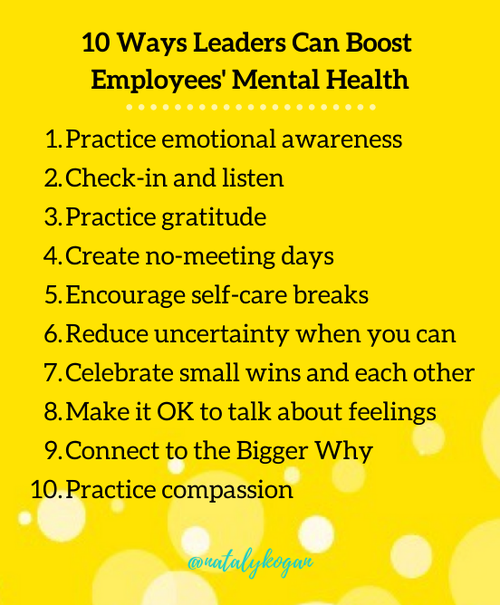
10 Practical Science-Backed Ways Leaders Can Support Their Employees’ Mental Health During Challenges

10 Practical Science-Backed Ways Leaders Can Support Their Employees’ Mental Health During Challenges

Happier.com | BY NATALY KOGAN | Mental Health | Health Insurance

As a leader, your job is not to manage people or projects — it’s to manage mental health, including your own.

During this really challenging time (understatement of the year!) that can be really intense and since we don’t learn about emotional fitness skills in MBA or leadership development programs, you don’t always know what to do.

The first thing you can do is make your and your team’s emotional and mental health your number one priority. You can’t give what you don’t have and your team members can’t give what they don’t have. If everyone is depleted and overwhelmed, it doesn’t matter how many motivating talks you give. As mountains of research show, we can’t do great work unless we fuel our well-being first.

Since the pandemic broke out, I’ve done 100+ virtual sessions on emotional fitness skills for teams and leaders and have led 3 virtual leadership development groups, to help leaders bring their full capacity to the challenges they are facing right now — and help people they lead do the same. 

Here are my 10 favorite science-backed tips to help you strengthen the emotional and mental health of people you lead — starting with your own.

10 Practical Science-Backed Ways Leaders Can Support Their Employees’ Mental Health During Challenges

1. Practice emotional awareness and openness

Whether you like it or not, as a leader, your emotions have an amplified effect on everyone else. So begin by practicing emotional awareness: Check in with yourself by asking “How am I feeling? What is my energy like?” (Do this first thing in the morning and before meetings.)

When your emotions vary from the norm (upset, stressed, more tense than usual) acknowledge them openly by telling people a little bit about why you feel that way. You don’t need to write a novel about your feelings — just share enough so the other person knows what’s up. This reduces stress and wasted energy for people trying to guess why you’re acting differently and gives them permission to share their emotions more openly.

2. Check-in and listen


Be intentional about checking in with your colleagues one on one to ask them how they are doing. This practice has 2 steps: (1) Ask them how they are and then (2) listen, giving them your full attention, without multi-tasking or trying to fix or give advice. During this challenging time when everyone feels more isolated, checking in with others is a powerful way to create moments of genuine human connection. (And no, you don’t always need to do it on Zoom — scheduling a quick check-in call works great!)

3. Practice Gratitude


During challenges and difficulties, the human brain’s natural negativity bias — being more sensitive to what’s wrong or negative — is in overdrive, making it easy to become overwhelmed with negative thoughts and even hopelessness. Practicing gratitude openly is the best way to counter the negativity spiral. 

Add Gratitude Bookends to your meetings: Begin a meeting by sharing something specific you’re grateful for or expressing your gratitude for someone else and at the end of the meeting, ask someone to do the same. This simple practice elevates the importance of gratitude for your team, encourages people to practice it on their own, and makes meetings more productive and collaborative.

4. Create no-meeting days

More on this topic…


Read More
100 Best Self Help & Personal Development Blogs and Websites

100 Best Self Help & Personal Development Blogs and Websites

Blog.Feedspot.com | Dec 27, 2022 | Personal Development Blogs | Shield Insurance Agency

The best Personal Development blogs from thousands of blogs on the web and ranked by traffic, social media followers, domain authority & freshness.

Personal Development Blogs

Here are 100 Best Personal Development Blogs you should follow in 2023

1. Zen Habits

San Diego, California, US
Zen Habits is about finding simplicity and mindfulness in the daily chaos of our lives. It’s about clearing the clutter so we can focus on what’s important, create something amazing, and find happiness. Leo Babauta is the Creator of Zen Habits living in San Diego, California.

2. Tiny Buddha Blog

 Los Angeles, California, US
Tiny Buddha is about reflecting on simple wisdom and learning new ways to apply it to our complex lives – complete with responsibilities, struggles, dreams, and relationships. Founded in 2009, Tiny Buddha has emerged as a leading resource for peace and happiness. The site features stories, tips, and insights from readers of all ages, from all over the globe.

3. Mark Manson Personal Development Blogs

New York, England, UK
Mark Manson’s personal development advice is nothing like the ordinary – forget clichéd or unrealistic tips. Mark’s goal with his site is to provide a reality-based form of self-help, and he most certainly achieves this goal with his articles.

4. Positivity Blog

Sweden
It’s a resource on how to live a happier life, increase your self-esteem and confidence, become more productive, simplify, and improve relationships and social skills.

5. Live Bold and Bloom

Asheville, North Carolina, US
Barrie Davenport blogs at her leading self-improvement blog, Live Bold and Bloom. Barrie is a personal growth seeker, published author, and certified coach. On live Bold and Bloom, Barrie helps people shift their thinking, create positive new habits, and build lifetime confidence.

6. Tim Ferriss Blog

US
Follow the Tim Ferris blog for tips and advice on success, motivation and more! Tim Ferriss has been listed as one of Fast Company’s ‘Most Innovative Business People’ and one of Fortune’s ’40 under 40.’ He is an early-stage technology investor/advisor and the author of five #1 New York Times and Wall Street Journal bestsellers.

7. Becoming Minimalist

Phoenix, Arizona, US
Becoming Minimalist inspires others to journey toward simple living. Own less, live more. We are dedicated to rational minimalism and discovering what that uniquely means for us. And the more who are introduced to this life-changing message, the better! Because we’re all just trying to make the most of this journey called life.

8. Gretchen Rubin

 New York City, New York, US
Gretchen Rubin is an author of several best selling books, including ‘The Happiness Project’ where she tests different happiness and personal development methods for one year. She writes about creating positive habits and finding happiness in the everyday life.

9. Marc and Angel Personal Development Blogsl

 Florida, US
Articles on happiness, productivity, emotional intelligence, relationships, health, aspiration, life, money, general self-improvement and more. Marc and Angel Chernoff are New York Times bestselling authors, professional coaches, full-time students of life, admirers of the human spirit, and have been recognized by Forbes as having ‘one of the most popular personal development blogs.’ They share inspirational advice and practical tips for life.

10. MindBodyGreen

Brooklyn, NY
MindBodyGreen is a lifestyle media brand dedicated to inspiring you to live your best life – mentally, physically, spiritually, emotionally and environmentally. Blog posts contains articles from nutrition, exercise and happiness to meditation and relationships.

Click here for more Personal Development Blogs…


Visit some of our recent blog articles from Shield Insurance!

Read More