5 ways to get the most out of your small business’s health insurance plan - Shield Insurance Blog

5 ways to get the most out of your small business’s health insurance plan

The Business Journals | By Cigna + Oscar | Oct 25, 2022 | Health Insurance

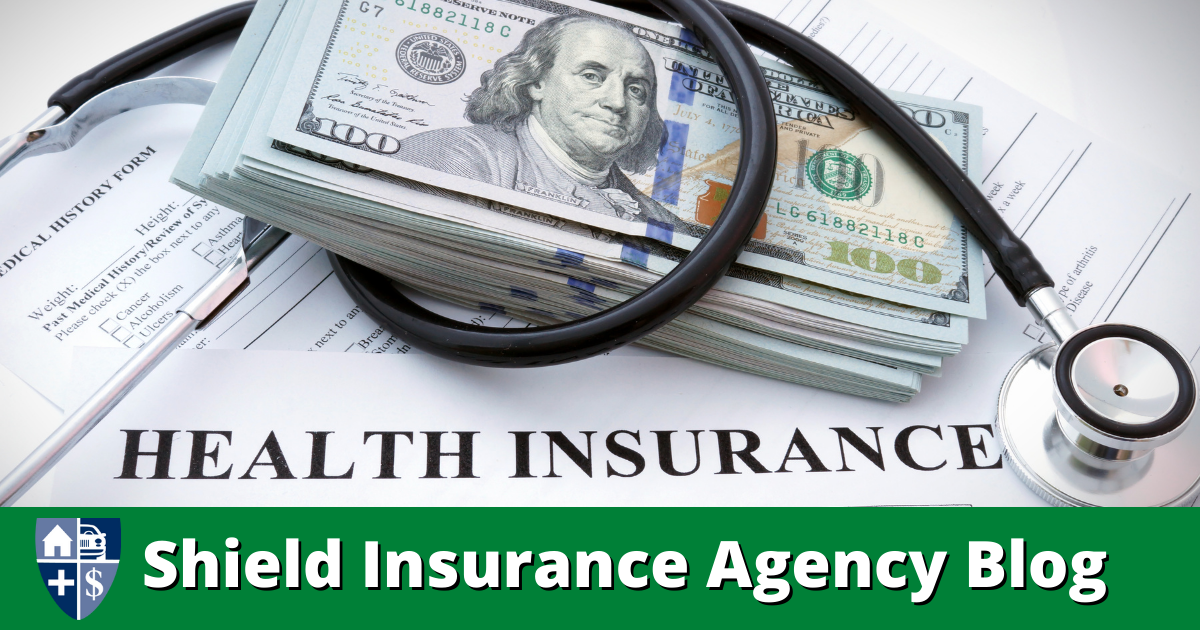
Whether you’ve just purchased small business health insurance or you’re shopping around, you’re probably aware that coverage can be costly, depending on the plan you purchase. According to a 2021 Kaiser Family Foundation report, the average annual premium was $7,739 for an individual and $22,221 for a family plan. Employers helped cover 83% of the costs for a single person and 63% of a family plan.

That’s why it’s critical to make the most of the plan you have — and help your employees stay engaged. Here are five key ways you can maximize your health insurance coverage, so your employees use the plan often, become healthier and help lower your business’s costs.

1. Emphasize the health insurance plan’s customer support programs and tools.

Some health plans offer dedicated customer support, online tools, and even concierge-like services that can help employees understand and use their plan. For example, Cigna + Oscar is unique in that it offers Care Guides, a team of professionals who help members find doctors and answer their questions about specific benefits and claims. Care Guides can also help coordinate care and prepare members for their upcoming procedures.

The more employees understand how their plan works, the more likely they are to use in-network providers, purchase generic medications, and rely on other cost-saving methods. In turn, this can help you, as an employer, lower your overall costs too.

2. Encourage your employees to manage their health insurance plan digitally.

If your health plan offers a mobile app, it may be where employees can access telemedicine services and prescription refill requests and even pay their premiums online. Encourage them to make the most of these convenient, digital services. After all, they help make your business’s health plan easy to use and can increase employee satisfaction.

If you’re shopping for a health plan now, look for one that offers digital services. You may want to ask your broker:

  • What telemedicine services are available to my employees, if any?
  • Is virtual urgent care available?
  • Can employees request prescription refills online?
  • Is there an easy way for employees to search if a doctor is in-network?
  • What other digital services are available with this health plan?

The bottom line: Today’s employees want to manage their healthcare at the click of a button. A convenient and easy-to-use mobile app and website can help them do that.

3. Communicate to employees about mental health care offerings.

Click here for the full story…


Find more great blogs from Shield Insurance Agency

Read More
4 Brothers Are Close to a World First, Nearing End of Epic 3000-Mile Row Across Atlantic–Raising 80k for Charity

4 Brothers, a 3000-Mile Row Across Atlantic, and 80k for Charity

4 Brothers Are Close to a World First, Nearing End of Epic 3000-Mile Row Across Atlantic–Raising 80k for Charity

Good News Network | Andy Corbley | Jan 11, 2023 | 4 Brothers | Boat Insurance

In a few days time, four brothers will set a world record as the first rowing team made entirely of brothers to cross the whole of the Atlantic.

While many siblings find being stuck under one roof challenging, it’s a testament to their endurance that the four of them have shared two rowing benches and one tent-sized cabin for nearly 4 weeks.

The adventurous brothers are two sets of twins—26-year-olds Jack and Hamish Friend, and 24-year-olds Euan and Arthur Friend.

The foursome from Devon, England have already raised more than 80k for charities since setting off on their epic endurance challenge nearly a month ago.

Naming their team ‘The FriendShip,’ they trained for the grueling feat for a total of 18 months ahead of their departure on December 12th from La Gomera, in the Canary Islands.

And they are expected to finally complete the Talisker Atlantic Challenge race and arrive at their destination, Antigua, in the next week. The Talisker Challenge usually consists of 20-40 rowing teams, and the boys’ latest diary entry claims they were in 4th, but gaining fast on 3rd place-holders.

“There have been some massive highs and some pretty low moments over the past 26 days,” said Hamish in a video, reflecting on their progress on Friday. “High moments from just surfing down some massive waves (…) and these amazing starry skies and amazing sunrises and sunsets.

“Low moments such as being slapped in the face by a flying fish at two in the morning, to getting absolutely soaked by these Atlantic storms that come along. Sitting in your cabin all damp and wet trying to get to sleep.”

Click here for the rest of the story and some great photos


More great blog articles with Shield Insurance Agency

Read More
Illinois man inhales drill bit into the lung during a dentist visit - Shield Insurance Blog

Illinois man inhales drill bit into the lung during a dentist visit

ABC30.com | Tuesday, November 15, 2022 | Drill Bit | Dental Insurance

Doctors believe that inhaling just before he coughed sent the drill bit deep into the 60-year-old’s airways.

KENOSHA, Wisconsin — This could be a dental patient’s worst nightmare.

What began as a routine visit landed an Illinois man in the hospital after he inhaled the dentist’s drill bit, WISN reported.

The CT scan tells the shocking story: An inch-long dental drill bit had lodged deep in Tom Jozsi’s lung.

“I was at the dentist getting a tooth filled, and then next thing I know I was told I swallowed this tool, so I didn’t really even feel it going down. All I felt was a cough,” Jozsi said.

Doctors believe that inhaling just before he coughed sent the metal object deep into the 60-year-old maintenance worker’s airways.

It was so deep, pulmonary expert Dr. Abdul Alraiyes said, that normal scopes couldn’t reach it.

“When I saw the CAT scan, and where that object is sitting, it was really far down on the right lower lobe of the lung,” said Alraiyes, intervention pulmonary director at Aurora Medical Center in Kenosha.

“What happens if he can’t get it out? And really the answer really was, part of my lung was going to have to get removed,” Jozsi said.

That’s when Alraiyes and the Aurora Kenosha team decided to try a newer device, one not designed for removing foreign objects.

“It’s more for early detection of cancer, especially lung cancer,” Alraiyes said.

He said it’s the size of a catheter.

Video of the scan showed the medical team was able to navigate the narrow airways, reach the drill piece and pull it out, without any harm to the patient.

“I was never so happy in my life when I opened my eyes and I saw him with a smile under that mask, shaking a little plastic container that had the tool in it,” Jozsi said.

It’s a souvenir Jozsi said he now keeps on a shelf at home.

The drill bit was in the man’s lung for four days.

The doctor who removed it said he has heard from colleagues in Michigan and Ohio who reported seeing cases nearly identical to this one.

See the video of the Drill Bit!


More great articles from Shield Insurance Agency Blog

Read More
Workplace Stress

Back to Basics: Workplace Stress

BLR | By Grace Hatfield, EHS Daily Advisor | Jan 9, 2023 | Workplace Stress | Business Insurance

Back to Basics is a weekly feature that highlights important but possibly overlooked information that any EHS professional should know. This week, we examine workplace stress and OSHA’s recommendations for addressing mental health.

Workplace Stress impacts the health and mental wellbeing of employees in every industry. According to OSHA, mental health challenges can include clinical mental illness, substance use disorders, and emotions like stress, grief, and feeling sad and anxious, even when these feelings are temporary and not part of a diagnosable condition. Even though workplaces can induce stress, they can also provide resources, solutions, and activities to help improve mental wellbeing.

Scope of the Workplace Stress Problem

OSHA says that workplace stress and poor mental health can negatively affect workers through job performance, productivity, work engagement and communication, physical capability, and daily functioning. More than 80% of U.S. workers have reported experiencing workplace stress, and more than 50% believe their work-related stress impacts their life at home. Workplace stressors can include the following:

  • Concerns about job security
  • Lack of access to tools and equipment needed to perform work safely
  • Fear of employer retaliation
  • Facing confrontation from customers, patients, coworkers, supervisors, or employees
  • Adapting to new or different workspaces, schedules, or rules
  • Having to learn new or different tasks or take on more responsibilities
  • Having to work more frequent or extended shifts
  • Being unable to take adequate breaks
  • Physically demanding work
  • Learning new communication tools and dealing with technical difficulties
  • Blurring of work-life boundaries, making it hard to disconnect from the office
  • Finding ways to work while simultaneously caregiving
  • Concerns about work performance and productivity
  • Concerns about the safety of using public transit to commute

These stressors can negatively affect a person’s mental health and sense of well-being, which can potentially contribute to serious problems, like the development or exacerbation of mental health challenges. Stressors can also lead to issues with productivity, happiness, and burnout.

Employer guidance and Workplace Stress

The goal should be to find ways to alleviate or remove stressors in the workplace to the greatest extent possible, says OSHA, and to build coping and resiliency supports, and ensure that people who need help know where to find it. Reducing workplace stress can improve morale and lead to increased productivity, better focus, fewer workplace injuries, fewer sick days, and improved physical health.

There are four key things that employers can do to help their workers manage and reduce stress. The first is to be aware and acknowledge that people can carry an emotional load that is unique to their own circumstances. Some people may experience heightened levels of loneliness, isolation, uncertainty, grief, and stress, while others may have additional responsibilities like caregiving for children or elderly household members. There are also those who already have existing mental health and substance use challenges.

Employers should identify factors that are making it harder for workers to get their jobs done, and determine if adjustments can be made. Leaders must also show empathy, by ensuring their employees that they are not alone, their employer understands the stress they are under, there is no shame in feeling anxious, and that asking for help is important.

The last key factor is providing access to coping and resiliency resources, workplace and leave flexibilities without penalty, or other supportive networks and services. OSHA says that research from the American Psychological Association suggests that 50% of employees find that a lack of paid time off or sick leave has a negative impact on workplace stress levels.

OSHA provides recommendations for senior managers and supervisors on how to get conversations started with employees about mental health. Senior managers should be transparent and avoid using negative or stigmatizing language when discussing mental health and workplace stress. They should stay positive and speak positively around everyone, and listen without judgment if a staff member reaches out.

Managers must be understanding and offer assistance, and model exemplary behaviors by demonstrating self-care behaviors. Lastly, they should adequately train frontline supervisors about mental health issues, so they have the skills and confidence to address these issues and recognize the signs and symptoms of emotional distress.

As for supervisors, they should find out if workers need help, and look for ways to redistribute tasks to minimize stress. They must monitor their own stress levels and make sure that they are taking care of themselves. Supervisors should be compassionate and understanding and look for signs of stress and mental health emergencies.

If there is concern about a worker experiencing a serious mental health or substance use challenge, encourage them to get help. Lastly, supervisors must know the facts, and OSHA recommends that they take training to learn about mental health issues.

Training with Workplace Stress

Learn more about workplace stress…


More great blog articles shared by Shield Insurance Agency

Read More
New Year’s Resolutions Statistics 2023

New Year’s Resolutions Statistics 2023

Forbes.com | By Sarah Davis | Jan 11, 2023 | New Year’s Resolutions | Shield Insurance Agency

The start of a new year serves as an opportunity for many to set new goals and commit to better habits. But what happens when the energy and excitement after the ball drops wear off—and how many New Year’s resolutions fail to come to fruition?

Below, we explore exactly what types of goals are set—and by whom—as well as what statistics say about the likelihood of those intentions turning into reality.

Interesting New Year’s Resolutions Statistics at a Glance

new survey from Forbes Health/OnePoll of 1,005 U.S. adults (conducted Nov. 18 through Nov. 28, 2022) looked at Americans’ attitudes surrounding resolution setting and what types of goals were prioritized.

Interestingly, the survey highlighted a couple of standout themes: Many people—particularly young people—are prioritizing their mental health over their physical health, and a decent portion of respondents feel pressured to set resolutions.

Specifically, the survey found:

  • 29% say they feel pressured to set a new year’s resolution.
    • Gen Z feels more pressure to set a resolution than any other generation (39%).
    • Men (35%) feel more pressured to set a resolution than women (28%).
  • Overall, 20% of people say improving mental health is a top priority in 2023 while 16% say improved physical health is more important to them.
    • 62% say physical and mental health is of equal importance.
  • More people cite improved mental health as a top resolution (45%) compared to improved fitness (39%), weight loss (37%), and improved diet (33%).
    • Women are more likely than men to cite improved mental health as a resolution (47% compared to 40%) while men are more likely to prioritize goals related to physical health, such as improved diet and fitness.
    • Baby boomers are more likely than any other age group to cite losing weight as a top resolution (54%).
  • 77% of respondents say they keep themselves accountable when it comes to sticking to their goals.
    • Of all groups, Gen Z is the least likely to cite themselves as the person responsible for keeping them accountable for their goals.
  • Overall, 81% of respondents feel confident in their ability to reach their goals, and only 5% lack this confidence.
    • Men are more confident (86%) than women (79%) in their ability to reach their goals.
  • Overall, only 6% of respondents cite reducing alcohol consumption as a top resolution.
    • Millennials are keener to give up alcohol than Gen Z (8% compared to 4%).
  • 52% plan on using a resource, such as an app, online platform, or membership, for assistance in sticking to their resolutions.
    • Men are more likely than women to rely on these resources (59% compared to 50%).
    • Apps are the most popular accountability tool.
  • 85% of respondents say their New Year’s resolution will have a positive impact beyond 2023.
    • 25% say that their resolution will have a positive impact for one to two years, and 57% believe it’ll have an impact for three years or more.

Most Common New Year’s Resolutions

For 2023, the Forbes Health/OnePoll survey found some resolutions to be more common than others, with the most popular goals including:

  • Improved mental health (45%)
  • Improved fitness (39%)
  • Lose weight (37%)
  • Improved diet (33%)
  • Improved finances (30%)

Less popular resolutions include stop smoking (14%), learn a new skill (12%) and make time for hobbies (11%). Notably, Gen Z is more likely to prioritize improved mental health as a 2023 resolution than any other generation (50%).

2023 New Year’s Resolutions By Age

Read more of the story at Forbes.com


More great blogs by Shield Insurance Agency

Read More
Jet setting over Pet sitting

Jet setting over Pet sitting

AmericanSeniors.org | Pet sitting | Special Event Insurance | Pet Insurance

Say goodbye to pet sitting and hello to jet-setting with your furry bestie! Options abound for your pet to join your vacation, whether you are flying, cruising, or driving to your destination.  Here’s what to keep in mind for traveling safely with your best friend – and how to find the best pet-friendly destinations.

Flying with Fido and Fluffy

Some airlines still have restrictions on pets traveling in their cabin, while others have returned to pre-COVID allowances.  Currently, Alaska Air, American Airlines, Delta, JetBlue, Southwest, and United Airlines allow pets in-cabin, as well as some overseas airlines like Air France.  For all airlines, pets need to fit comfortably inside a carrier that can tuck completely under the seat in front of you.  Your pet needs to be able to stand up and turn around in the carrier.  Make sure you double-check with your airline what their specific requirements are since they all vary. 

Allow your pet plenty of time to acclimate to the carrier long before your flight.  Set the carrier out in the house, with treats placed inside.  This positive association will encourage your pet to spend a longer time inside the carrier.  You can also take your pet for a drive inside the carrier to help acclimate to movement as well.  

Label the carrier with your name and phone number, and inside, you can place a potty pad to soak up any accidents.  Your pet’s favorite toy would be a comforting addition too.  

Five hours before the flight, stop feeding your pet, though water should still be made available.  Allow your furry best friend as much exercise as possible until boarding.  It is generally not advised to give your pet a sedative unless it’s specifically recommended by your vet. 

Cruising: Only with Cunard

If you dream of sailing the seas with your furry best friend, there is one cruiser that will welcome humans and pets alike.  Cunard’s Queen Mary 2 is actually the only cruiser that allows a limited number of dogs and cats to set sail.  However, they aren’t allowed to stay with you in your cabin.  Cats and dogs must stay in The Kennels for the entire duration of the cruise.  You are allowed to visit during specific hours, but they won’t be able to join you for walks around the deck.  There is a very long waiting list, as there are only 24 kennels aboard the ship.  Costs range from $800-$2000, depending on the size of your pet. 

It is a beautiful trip, which perhaps is another reason why the waiting list for The Kennels is quite long.  Queen Mary 2 sails transatlantically from NY to Hamburg, Germany.  En route, it comes into port in charming Southampton, the British waterfront city that’s home to history abounding, including the Titanic Trail and 950-year-old St Michael the Archangel Church.  Stonehenge is just a stone’s throw away. 

Road Tripping Together 

Of course, the most flexible way to travel with your pet is to enjoy a road trip together.  The most important consideration here is keeping Fido or Fluffy safe.  A strappable crate or appropriately fitted seat belt attachment will make sure your beloved pet stays safe in an accident (and prevents them from distracting you while driving).  The safest place is the back seat for pets, far away from the front airbags that can be fatal for their small stature.  Practice driving shorter distances to help your pets acclimate to the restraint.  Remember the treats! 

Currently, in beta, Go Pet Friendly has a road trip planner that is helpful for planning the best drive for both species.  You can ask for recommendations for pit stops for all of your legs to stretch and play. 

Friendly Tails Pet Sitting

Bring Fido is an excellent resource for trip planning with your furry best friend.   Browse pet-friendly hotels, restaurants, activities, and even events.  

Pet-friendly accommodations are on the rise, with many chains welcoming your pet to stay for free.  Red Roof Inn allows for one free pet per room, as do many Four Seasons properties.  Other chains like the Ritz Carlton and Westin welcome dogs, but have varying fees and restrictions.  The AKC has a full listing of dog-friendly hotel chains and specifics. 

The Pet Sitting Checklist

Click here for the full checklist…


More great blog articles by Shield Insurance Agency
Read More
General Information about Blood and Blood Donation

January is Blood Donation Month

AmericasBlood.org | May 2022 | Blood Donation | Medical Insurance

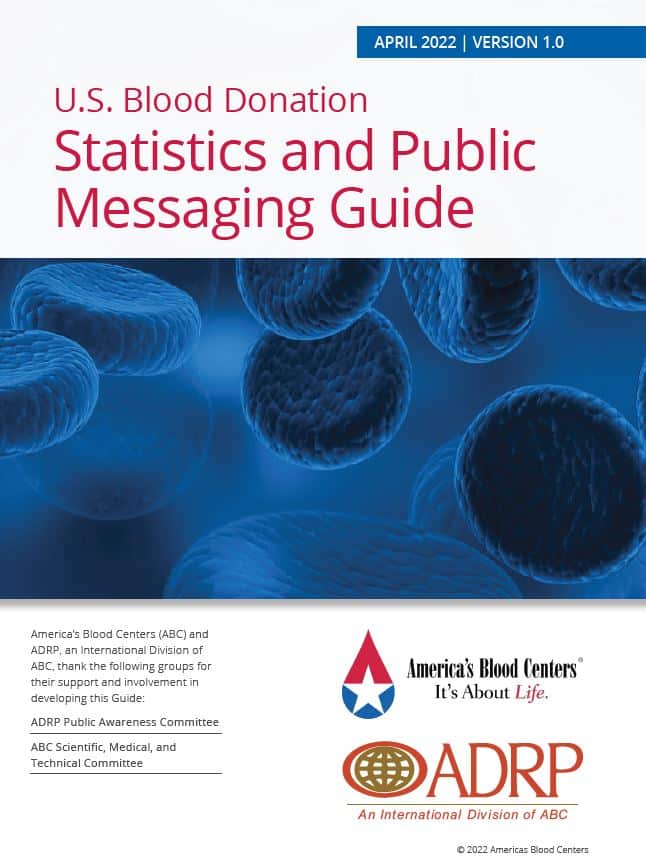
U.S. Blood Donation Statistics and Public Messaging Guide

Over 40 verified statistics from published research.

blood donation statistics

Designed for blood centers, media, and anyone who is generally interested in the current state of blood donations and utilization, this guide is the first of its kind designed to provide the latest look at America’s blood supply and its donors. It uses data curated from published research, credible public sources, and input from industry experts. We encourage readers to use the editable social media graphics contained in this guide that highlight the 13 of the most widely used statistics.

This Guide will be updated annually to reflect the latest statistics.  

General Information about Blood and Blood Donation

Q1.1:  do blood donations help patients in need?

■ Every donation can help save a life.

■ Each donation can help save or deeply impact more than one life.

Q1.2: How many patients can each blood donation help?

■ One donation can help two or more patients in need. Each donation can be separated into more than one blood product including but not limited to red blood cells, plasma, and platelets.

■ Some donations result in two or three of the same type of product, just more doses for patients (e.g., double red blood cells, plasma from automation, or platelets from automation). 

■ Each traditional whole blood donation can be separated into different blood product components in the lab (red blood cells and plasma) and depending on the amount of  time from donation to the lab, additional products can be made such as platelets and cryoprecipitate which are used in cancer treatment and heart surgeries.

Q1.3: How many blood centers are there in the U.S.? How much do they collect?

According to the United States (U.S.) Food and Drug Administration’s (FDA’s) Blood Establishment Registration database1, there are 53 community blood centers and 90 hospitalbased blood centers in the U.S. Independent, community blood centers collect approximately 60

percent of the nation’s blood supply and the American Red Cross collects approximately 40 percent.

Q1.4: How often can individuals donate blood in the U.S.?

Individuals can donate whole blood no more than once in eight weeks.

Individuals can donate platelets (apheresis donation) as much as twice in a seven-day period — or up to 24 times in a rolling 12 months.

Individual blood centers may apply additional policies.

Q1.5: How many pints of blood do people have in their body?

An average adult has about 10.5 pints of blood in their body.

Q1.6: What is the prevalence of each blood type among the U.S. population?

The approximate distribution of blood types in the blood donor population is as follows.

Distribution may be different for specific racial and ethnic groups and in different parts of the country.

TABLE: PREVALENCE OF BLOOD TYPE 7 BLOOD TYPE PREVALENCE HOW COMMON IS YOUR BLOOD?

O Rh-positive 39% 1 in 2.5
O Rh-negative 7% 1 in 11
A Rh-positive 32% 1 in 3
A Rh-negative 6% 1 in 17
B Rh-positive 11% 1 in 11
B Rh-negative 2% 1 person in 50
AB Rh-positive 4% 1 person in 25
AB Rh-negative 1% 1 person in 100

Click here to visit the full report on U.S. blood donation…


More interesting reads by Shield Insurance Agency

Read More
10 Practical Science-Backed Ways Leaders Can Support Their Employees’ Mental Health During Challenges

10 Practical Science-Backed Ways Leaders Can Support Their Employees’ Mental Health During Challenges

Happier.com | BY NATALY KOGAN | Mental Health | Health Insurance

As a leader, your job is not to manage people or projects — it’s to manage mental health, including your own.

During this really challenging time (understatement of the year!) that can be really intense and since we don’t learn about emotional fitness skills in MBA or leadership development programs, you don’t always know what to do.

The first thing you can do is make your and your team’s emotional and mental health your number one priority. You can’t give what you don’t have and your team members can’t give what they don’t have. If everyone is depleted and overwhelmed, it doesn’t matter how many motivating talks you give. As mountains of research show, we can’t do great work unless we fuel our well-being first.

Since the pandemic broke out, I’ve done 100+ virtual sessions on emotional fitness skills for teams and leaders and have led 3 virtual leadership development groups, to help leaders bring their full capacity to the challenges they are facing right now — and help people they lead do the same. 

Here are my 10 favorite science-backed tips to help you strengthen the emotional and mental health of people you lead — starting with your own.

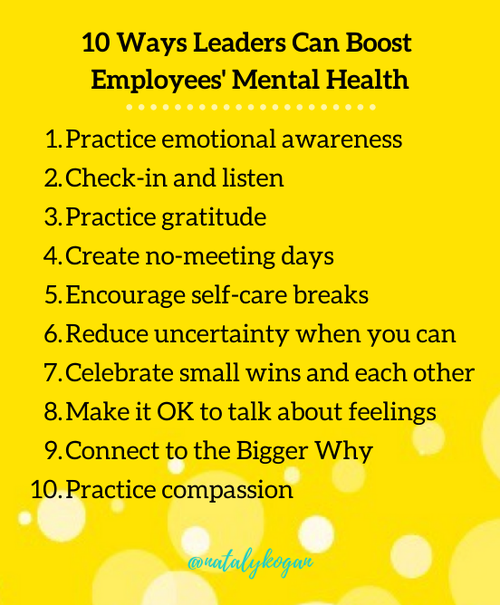
10 Practical Science-Backed Ways Leaders Can Support Their Employees’ Mental Health During Challenges

1. Practice emotional awareness and openness

Whether you like it or not, as a leader, your emotions have an amplified effect on everyone else. So begin by practicing emotional awareness: Check in with yourself by asking “How am I feeling? What is my energy like?” (Do this first thing in the morning and before meetings.)

When your emotions vary from the norm (upset, stressed, more tense than usual) acknowledge them openly by telling people a little bit about why you feel that way. You don’t need to write a novel about your feelings — just share enough so the other person knows what’s up. This reduces stress and wasted energy for people trying to guess why you’re acting differently and gives them permission to share their emotions more openly.

2. Check-in and listen


Be intentional about checking in with your colleagues one on one to ask them how they are doing. This practice has 2 steps: (1) Ask them how they are and then (2) listen, giving them your full attention, without multi-tasking or trying to fix or give advice. During this challenging time when everyone feels more isolated, checking in with others is a powerful way to create moments of genuine human connection. (And no, you don’t always need to do it on Zoom — scheduling a quick check-in call works great!)

3. Practice Gratitude


During challenges and difficulties, the human brain’s natural negativity bias — being more sensitive to what’s wrong or negative — is in overdrive, making it easy to become overwhelmed with negative thoughts and even hopelessness. Practicing gratitude openly is the best way to counter the negativity spiral. 

Add Gratitude Bookends to your meetings: Begin a meeting by sharing something specific you’re grateful for or expressing your gratitude for someone else and at the end of the meeting, ask someone to do the same. This simple practice elevates the importance of gratitude for your team, encourages people to practice it on their own, and makes meetings more productive and collaborative.

4. Create no-meeting days

More on this topic…


Read More
10 Things You Need to Know About Social Security

10 Things You Need to Know About Social Security

Answers to frequently asked questions about your retirement benefits

AARP | Andy Markowitz | Updated June 21, 2022 | Social Security | Life Insurance

Social Security provides benefits to more than 65 million people, and those monthly payments have an enormous impact on older Americans’ financial health. According to Census Bureau data:

  • Social Security accounts for at least 50 percent of income for more than half of households headed by someone 65 or older.
  • It provides nearly 80 percent of income for 1 in 5 such households.
  • It keeps more than 26.5 million people from falling below the poverty line.

An institution that looms so large in American life is bound to generate questions about what it does and how it works. Here are the answers to some of the most frequently asked questions about Social Security. You’ll find more detailed information on these issues in AARP’s Social Security Resource Center.

1. Is Social Security just for retired workers?

No. As of April 2022, 72.7 percent of beneficiaries were retirees. The remainder were spouses, ex-spouses and children of retirees (4.3 percent); disabled workers and their families (14 percent); and survivors of deceased beneficiaries (9 percent).

2. At what age can I start collecting Social Security benefits?

You can begin receiving retirement benefits at age 62, but your payments will be more significant if you wait until your full retirement age (66 years and 4 months for people born in 1956, gradually rising over the next few years to 67). If you are eligible for survivor benefits or Social Security Disability Insurance (SSDI), you can start collecting earlier.

3. How do I sign up for Social Security?

You can apply for retirementspousal or disability benefits online, by phone at 800-772-1213, or at your local Social Security office. For survivor benefits, you can apply by phone or in person. Local offices reopened to walk-in traffic in April after being largely closed to visitors for more than two years due to the COVID-19 pandemic. Still, the Social Security Administration (SSA) strongly recommends calling ahead to make an appointment.

4. How long do I need to work to become eligible for benefits?

For retirement benefits, at least 10 years. Social Security uses a system of credits, which you collect by working and paying Social Security taxes. You can earn up to four credits a year, and you need 40 credits to qualify for retirement benefits. The credit threshold may be lower for disability benefits.

No, you can receive benefits while working. But if you are below full retirement age and earn more than a certain amount, your monthly benefits will be temporarily reduced. Once you reach full retirement age, the reduction is eliminated, and your benefits will be increased to make up for what was lost over time.

5. Must I stop working to collect retirement benefits?

No, you can receive benefits while working. But if you are below full retirement age and earn more than a certain amount, your monthly benefits will be temporarily reduced. Once you reach full retirement age, the reduction is eliminated, and your benefits will be increased to make up for what was lost over time.

6. How much will I get from Social Security?

That depends on a number of factors, most crucially your lifetime earnings from work in which you paid Social Security taxes. Social Security takes your 35 highest-earnings years, calculates an inflation-adjusted average, and plugs that into a progressive formula that determines your “basic” benefit. The amount will also be affected by how old you are when you claim benefits. You won’t know it for sure until you file, but you can use the AARP Social Security Calculator to get an estimate.

7. What’s the maximum monthly Social Security benefit? 

Read more…


More great reads from the Shield Insurance Agency Blog

Read More
10 Wellness Trends From 2022 That Experts Say You Should Keep In 2023

10 Wellness Trends From 2022 That Experts Say You Should Keep In 2023

From fitness to trauma healing to your “villain era,” here are the wellness trends experts say are actually useful.

HuffPost.com | Jillian Wilson | Dec 14, 2022, 12:24 PM EST | Trends | Shield Health Insurance

A lot of things trend on social media, and many of those trending topics aren’t good. In fact, they can be pretty harmful (looking at you, NyQuil chicken). But, like all trends, they capture attention for a reason — some of these popular topics even prove pretty useful.

In the wellness world, including fitness and mental health, hundreds of trends have come out this year or simply grown in popularity. From hot girl walks to healing your inner child, many healthy trending topics are in the zeitgeist for a good reason.

And just because they’re trending now doesn’t mean they need to end in 2023. If anything, they should be continued and explored more. Lindsay Monal, a yoga teacher at YogaRenew Teacher Training, said that it’s important to follow the trends that you like and that will keep you consistent in your practice, whether mental health or fitness.

Here are the most useful fitness and mental health trends of 2022, according to experts:

Mental health trends

End of people pleasing and entering your “villain” era

The simple search “villain era” on TikTok brings up thousands of videos that showcase people putting an end to people pleasing and embracing their so-called villain era.

But while boundary setting and putting an end to people pleasing are both valuable for your mental health, there is something wrong with this being phrased as villainous behavior, according to Sarah Sarkis, an executive coach and senior director of performance psychology at Exos, a corporate wellness company.

“The ‘villain era’ is really an inaccurate depiction of people setting healthy boundaries,” Sarkis said. “While the trend means well, we shouldn’t be vilifying taking a step away from pleasing others to prioritize our own needs and well-being.”

She asked: “If we are always pleasing other people but never addressing our own needs, who are we actually being a villain to? Ourselves perhaps? Is that OK?” The answer: No, it is not.

She noted that burnout (think: holiday stress, work stress, family pressure and more) is a significant driver of this end of people pleasing. “We’re starting to see this shift to reverse years if not generations worth of conditioning to put others’ needs before our own,” Sarkis said.

Healing your inner child

Here is the rest of the story…


Here are some more great reads!

Read More